Thursday, 12 January 2012

Two more fossils, Bannockburn.

In a previous post, I wrote about fossils from Bannockburn in Central Otago.  We went back there next day and found these:
Fern leaf fossil, Bannockburn

I'm guessing this is a kauri (Agathis) or Araucaria cone scale.

I also promised references.  You'll find an entry to Daphne Lee's publications here.


Plant life in Doubtful Sound

The second adventure in the Lewis & Clark College 2012 New Zealand course was a cruise through Doubtful Sound on the Fiordland Navigator.  Learning objectives included (1) the influence of fresh water in the fjord, especially since the outflow of the Manapouri Power Station brings additional large amounts, (2) bird recognition, and (3) an overview of the vegetation changes and introduction to key plant species.
We had permits to take small bottom samples with a grabber under supervision of Dr Lucy Jack from Otago University, who also had brought a remote-controlled mini submarine with a camera for viewing marine life.  The night before, Lucy outlined the features of the environment and some of the research findings of the team she works with.
The bird life was evident from the ship and also from kayaks and tender boats.  Among others we saw variable oystercatchers (with chick), kaka, tomtits, shags, and a mollymawk at the fjord entrance.
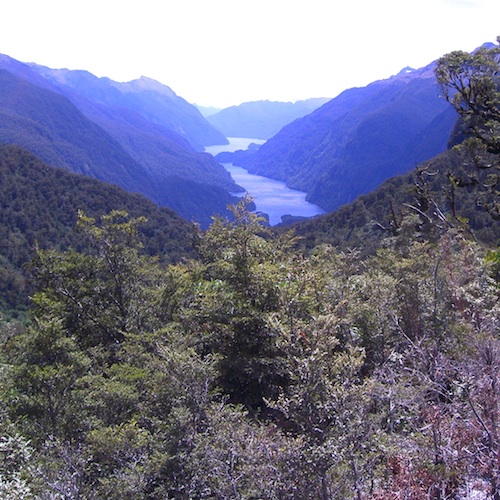
Doubtful Sound from Willmot Pass
The plant life changes dramatically from the head of the catchment at Willmot Pass to the open coasts.  The road at the pass is close to timberline which is about half-way up the mountains there.  Above timberline snow tussock and alpine plants predominate, but the forest at the pass is dominated by silver beech, Nothofagus (sect. Lophozonia) menziesii, with ribbonwood (Hoheria lyallii) on slips and roadsides.  This is the zone of highest rainfall, which suits silver beech, although we saw it in dry conditions.
Black beech, Nothofagus solandri.
Black beech, Nothofagus (sect. Fuscospora) solandri, is dominant at sea level in the inner fjord.  Other plants here include fuchsia (Fuchsia excorticata), pate (Schefflera digitata), and putaputaweta (Carpodetus serratus).  It was a nice surprise to see Breaksea Girl moored here; I went to Campbell Island on her in 2004.
Putaputaweta, Carpodetus serratus.

Breaksea Girl
In the outer fjord, and especially on the shores of Secretary Island, rimu (Dacrydium cupressinum) is more common, along with yellow-silver pine (Lepidothamnus intermedius).  Other podocarps there include miro (Prumnopitys ferrugineus), tanekaha (Phyllocladus alpinus), and totara (Podocarpus totara).  Black beech is abundant here too.  Rata was also common, a few still in flower.
Southern rata, Metrosideros umbellata, in flower.
Outside the fjord, rocky coasts are exposed to the full force of the westerlies and the salt spray they carry.  Veronica (sect. Hebe) elliptica and Brachyglottis rotundifolia dominate the coastal scrub.
Salt-tolerant coastal scrub on one of the islands that guard the fjord entrance
The huge landslide below was caused by the 2003 Secretary Island earthquake (M 7.1).

A prominent plant on the rocky shores of the fjord is Olearia oporina, which was flowering freely.  
Olearia oporina
Tree branches overhanging the water were heavy with epiphytes, including the orchid Dendrobium cunninghamii flowering freely.

Epiphytes on beech.
Overnight we were treated to heavy rain, so the waterfalls were in full flow next morning as it cleared. 

The second night was clear and many students stayed on deck until midnight to watch the Southern Cross and other unfamiliar stars rise above the surrounding peaks.
The trip was an excellent introduction to temperate New Zealand rain forests, sandwiched between the dry lands of Central Otago and the beech-free zone on Stewart Island.  Access by land to these extreme forests is impossible, certainly in the time we had available.  The crew of Fiordland Navigator gave the students and staff an unparalleled wildlife trip.

Sunday, 1 January 2012

Fossil plants from the Miocene of New Zealand.

For the next couple of weeks, I’m travelling in the southern South Island of New Zealand with a group of students from Lewis & Clark College in Oregon, USA.  The main objectives of their trip are biological, but there are inevitable cultural aspects to a trip like this too.  For me, a by-product of a trip like this is blog-fodder.
Lewis & Clark group at Bannockburn
Some of the most impressive evidence of evolution comes from fossils, especially fossils of animals and plants that no longer exist, but for which we can see clear similarities with living species.  But even if there were no fossils, there's still plenty of evidence of evolution.
Today (2 January 2012) we visited a fossil deposit near Bannockburn, Central Otago.  This is a flaky mudstone that was laid down in layers in an old lake bed, between 14 and 19 million years ago.  The fossils here are mostly leaves, but similar deposits have contained remnants of a crocodile and a small mammal.  Plant fossils from this formation and their implications have been described in a series of papers by Daphne Lee of Otago University and her colleagues.
There are bedded leaves that look almost like raked-up autumn leaves, and others that are impression fossils between layers of the mudstone.  The commonest plants here are Eucalyptus, Acacia, Casuarina, and the Protea family (Proteaceae).  These plants are mostly absent from New Zealand today, and they shout out an affinity with just one modern location: Australia. 
Eucalyptus ancient & modern.
Geologists tell us that New Zealand in the Miocene was low-lying with a subtropical climate.  The low relief implies low soil fertility as minerals are leached out of the stable top soils.  The lack of mountains suggests perhaps a lower rainfall than today too.  In other words, it was an environment where Australian plants would feel right at home.
Casuarina infructescence.
Among these Australian plants, there are fossils of familiar New Zealand groups.  We found leaves that look like rimu (Dacrydium cupressinum), tutu (Coriaria arborea), New Zealand flax (Phormium), Coprosma, and southern beech (Nothofagus).  (I say “look like” because identifying fossils is a specialised skill.)
This impression fossil of scale leaves spiraling on a stem looks to me like a conifer.
So what happened to the Australian plants that dominated the New Zealand flora in the Miocene?  From no more than 10 million years ago, mountain uplift began and the New Zealand alpine fault became active.  The main mountain uplift is even more recent, only 1–2 million years old.  With this uplift came erosion, releasing minerals from the disturbed rocks, higher rainfall as the mountains intercepted the prevailing winds, and these coincided with a global cooling of the climate.  Eucalyptus, Acacia, and Casuarina went extinct at this time.  We lost most of our Proteaceae too, with only Knightia and Toronia persisting in the modern flora.  Meanwhile other groups invaded and some of them became dominant, especially in the new mountains.
This view of New Zealand’s history is supported by the fossil record and by new techniques that compare the relationships of plants using DNA sequences.  It seems the old view of an ancient flora that persisted here since New Zealand split from Gondwana 80 million years ago just doesn’t stack up any more.
I hope to add more pictures, hyperlinks, and references as soon as I get a faster connection to the internet.  (Posted here 13 January 2012)

Friday, 30 December 2011

Wandering Willy

One of the worst weeds in disturbed bush remnants (and some barely tended gardens I'm a bit familiar with) is wandering willy, or Tradescantia fluminensis.  The genus is found in North and tropical America and is named after John Tradescant, who was gardener to Charles the First.  (First aside: there's a family story that we're descended from Col. John Jones, who married Oliver Cromwell's sister and signed Charles's death warrant, but I've been unable to verify it and for several reasons it seems unlikely.) (Second aside: Philippa Gregory's two historical novels about the Tradescants, Earthly Joys and Virgin Earth, are good reads.)
Tradescantia fluminensis
Wandering willy used to be called wandering Jew in New Zealand, but that's considered offensive, and along with similar common names like wild Irishman and Spaniard has largely disappeared. I'm not sure that puritans, like Cromwell and others of his time, would have approved of wandering willy either.


Tradescantia is flowering well this year.  At least I think it is, but I don't have quantitative data to verify my impression.  Normally I'm aware of occasional flowers, but this year I've noticed a lot of flowers.  It'll be interesting to look for fruit later.  It's not easy to verify such impressions without counting and measuring, and that requires keeping a notebook year after year.


Tradescantia is a serious weed because it's rapidly spread through fragments of stem that can root easily.  Almost any attempt to control it manually is destined to just spread it further (at least that's my excuse for letting it run rampant in my garden).  And of course avoiding tip fees by dumping garden rubbish in gullies and on roadsides just spreads weeds further.

Thursday, 29 December 2011

Urban forest remnants; the balance between planting and killing

Wellington abounds with small forest remnants in gullies and on hillsides, most of them second-growth.  Many of them have dedicated "friends" groups that plant and weed to encourage the natives and discourage the invaders.  My local patch is the Birdwood Reserve, which is continuous with its more glamorous neighbor the Karori Wildlife Sanctuary, now rebranded as Zelandia.

Kaka, Birdwood reserve.

Birdwood Reserve is kohekohe/titoki/mahoe forest, with some kotukutuku thrown in and a lot of kawakawa in the understory.  Tui and kaka are the common native birds, along with fantails and silvereyes.  Once I saw a tieke.  There are a few big cherries and sycamores that'll have to be removed some day, and some agressive introduced climbers, particularly old man's beard.  Around the edges it suffers the usual urban fates of rubbish dumping, landslides, clearing, and vandalism; there are road cones, a bicycle, a bathroom sink, roofing iron, and old election hoardings flung down the bank.

Sprayed understory, now collecting weeds and rubbish.
A few years ago I started planting out there a few natives (mahoe, ngaio, rangiora, matipo, makomako) that had come up in odd corners of my garden where wind or birds had dropped the seeds.  Each year I'd plant out a dozen or so, and a few of them are now quite big.  But each year someone would decide the area needed tidying up, and would organise for the weeds along the paths to be sprayed.  Whenever this happened I'd lose about half my plantings to spray drift.

Spraying has yellowed the leaves on this planted karamu (Coprosma robusta), but the orange-flowered Tropaeolum majus  appears unharmed.
Worse than that though, the spraying has eaten into the original bush edge, mostly by killing off the kawakawa, which is particularly sensitive, so that the area needing replanting keeps getting bigger.  The understory and bush margin dies, then the wind gets in and tears branches from the trees.  It's a steep bank, and prone to slips after heavy rain; there have been two quite big ones in recent years, both following vegetation clearance.  Before you know it, weeds, especially wandering willy, have invaded under the trees, so that next year's tidy-up has to go further from the path.  In places, where once there was a sharp and impenetrable bush edge at the path, there's now an ugly bare and dying area, and you can see 10–20m into the bush.

Spraying has isolated a titoki and a mahoe (left) by opening a gap right through the forest where once was dense undergrowth.
I've tried to discuss this with the Council.  They were concerned and helpful.  But my impression is that the team that manages reserves is different from the team that manages weeds.  In response, the council generously offered to provide me with more plants, free from their own nursery, if my group (i.e., me) would plant them.  But I don't see the point of planting more until the sprayers are brought under control.  And as a ratepayer, I also don't see the point of raising plants in a nursery, planting them out, and then killing them.

Sprayed Crocosmia xcrocosmiiflora.  Vandals repeatedly damage the fences, pushing over posts and ripping off the rails.

The plant names

cherry
Prunus spp.
kawakawa
Piper excelsum
kohekohe
Dysoxylum spectabile
kotukutuku
Fuchsia excorticata
mahoe
Melicytus ramiflorus
makomako
Aristotelia serrata
matipo
Myrsine australis
ngaio
Myoporum laetum
old man’s beard
Clematis vitalba
rangiora
Brachyglottis repanda
sycamore
Acer pseudoplatanus
titoki
Alectryon excelsus
wandering willy
Tradescantia fluminensis

Thursday, 8 December 2011

Is there a lower limit to flower size?

How small could a flower get?  In a previous post I mentioned New Zealand's smallest flower, Wolffia arrhiza.  The smallest New Zealand flower that has a corolla and so looks like a flower however, is considerably bigger (Myosotis brevis, at 1 mm diameter).  But what's the smallest a flower could be?

Most flowers are hermaphrodite, but there are plenty of flowers that are either male or female.  But for the sake of argument, let's say our flower must be hermaphrodite.  It needs a pistil and at least one stamen, but maybe it doesn't need petals (corolla) and sepals (calyx).

The pistil is the female part of the flower.  Let's keep it as simple as possible, a single carpel with a single ovule (the ovule becomes the seed).  The carpel is a modified leaf, and its wall needs an epidermis on each side (say 10 µm thick), and a minimum of 1–2 layers of mesophyll in the middle, cells that are probably at least 15 µm ; that's a layer 4 cells in thickness (say 50 µm ) wrapped around the ovule.  The ovule can have a single integument if it's an Asterid (other flowering plants have 2 integuments), maybe 2 cells in thickness.  Inside that is a single layer of nucellus (megasporangium wall), and inside that an embryo sac of 7 cells.  The whole ovule could be shrunk down to about 100 µm (the lily ovule featured in first year textbook Raven Evert & Eichhorn is about 400 µm across).  The ovule needs a vascular supply, but it it's orthotropous (erect on its stalk) the thickness of a vascular bundle doesn't need to be added to the flower's diameter.  So the single ovule surrounded by  carpel wall could be about 200 µm diameter.

The stamen could similarly be reduced.  If this tiny flower is cleistogamic, maybe it doesn't need complex walls like a lily stamen has (200 µm thick).  Maybe 50 µm is enough, like the carpel wall.  The smallest pollen grains are about 10 µm , and even a cleistogamic flower will need more than one of them.  Firstly, because pollen grains develop from spores, and spores are produced by meiosis, 4 would be a theoretical minimum (without abortion, such as happens in the ovule).  Secondly, even a habitual self-pollinator needs an excess of pollen grains to ovules, maybe 20–30:1 at a minimum.  The internal volume of the anther couldn't be much smaller than about 30 µm diameter; adding the wall on both sides would make it about 130 µm across.

Such a flower doesn't have to have the pistil and stamen packed side by side.  If the ovary of the pistil overlapped the filament of the stamen, and the anther of the stamen overlapped the style of the pistil, they could fit together into a smaller space.  The resulting flower is about 230 µm diameter, a pretty good match for Wolffia arrhiza at around 250 µm.

Friday, 2 December 2011

Diggers' speedwell

People are starting to get used to the idea that the hebes and parahebes of New Zealand really do belong back in the genus Veronica, where they were first classified by Forster after Cook's second voyage.  Our 120+ species of shrubby hebes, subshrubby speedwell hebes & sun hebes, and cushion plant snow hebes are an amazing group of plants that have diverged from the standard northern veronicas in many different ways.  They're classified now as Veronica section Hebe, and their sister group (with a shared ancestor in common) is the Australian Veronica sect. Labiatoides.

Diggers' speedwell is one of these Australian veronicas (Veronica perfoliata).  It grows in south-eastern Australia and it's occasionally cultivated in New Zealand.  This rather straggly plant has been growing in a pot, but given a good spot in the garden it will adopt a nice rounded form from a bunch of new shoots that arise from the rootstock each spring.  The leaves are very Eucalyptus-like, bluish green and very firm, and joined in opposite pairs to surround the stem—that's what perfoliate means.  In fact if you saw it when not in flower, you'd probably think it was a gum tree seedling.

The flowers are a strong mauve colour, with a little pink surrounding a dense tuft of glassy hairs in the centre.  These long glassy hairs are found in quite a few of the Australian species (like V. derwentiana and V. nivea), but we don't see anything like them in New Zealand Veronica.  It's easy to propagate from cuttings.  You can cut the stem up just above every pair of leaves, so each internode makes a good cutting.

Just as our veronicas have evolved away from the northern type here in New Zealand, so have their relatives in Australia.  The similarity to a eucalypt isn't an accident; such sclerophyllous leaves are adaptive in the Australian environment and common in many unrelated plant groups.