Sunday, 30 October 2011

Why are kawakawa falling over?


In Birdwood Reserve, near where I live, there’s been an epidemic of some sort affecting kawakawa, Piper excelsum.  Large plants lose their leaves and the roots seem to die off, because the whole plant falls over, as if wind-thrown.  There are still plenty of small plants alive, so it's not wiping them all out:

Kawakawa is very susceptible to spray damage, and certainly some of these dead plants are alongside tracks where weeds have been sprayed lately.  I’ve found the slightest spray drift of glyphosate is enough to wither kawakawa leaves and slowly kill the plants.

But some of these plants were growing where I don’t think there would have been any spraying, so I’m wondering if a disease is involved.  Indeed one such dead plant is in my garden, where I certainly haven't sprayed, but where nevertheless quite a few plants (not just kawakawa, but also northern rata (Metrosideros robusta) and akeake (Dodonaea viscosa)) have suddenly died.  The weather has been normal, except for the snowfall in August. 
In cabbage trees (Cordyline) sudden decline is caused by a phytoplasma.  This is an extremely small bacterium that's spread by sap-sucking leaf hoppers.  So far it's been implicated in deaths of cabbage trees, strawberries, coprosmas, and Phormium (New Zealand flax) (Liefting et al., 2007).  I've no reason to suspect any particular cause in this case, but the cabbage tree disease does show how devastating these things can be.
I'd be interested to hear if anyone else has observed similar collapse of kawakawa anywhere.
Reference
Lia W. LIEFTING, Ross E. BEEVER, Mark T. ANDERSEN, Gerard R. G. CLOVER Phytoplasma diseases in New Zealand.  Bulletin of Insectology 60: 165-166 (2007).

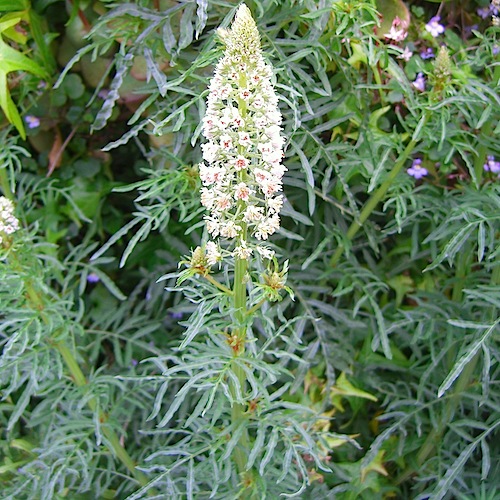
White mignonette


Reseda alba, Karori, Wellington, New Zealand


Resedaceae is a small family in the glucosinolate-producing Order Brassicales.  Reseda alba, white mignonette, is a cottage garden flower grown for the sweet scent of the flowers, and it’s naturalized in New Zealand.  These ones were semi-wild on a crib wall in Karori, Wellingon.

Saturday, 15 October 2011

Wellington coast at Makara

We took a great little walk today from Makara towards Opau Bay, along a section of Wellington coast.  The walk itself is described here, but I want to write about some of the plants.
The coastal cliffs are formed along the Ohariu Fault, one of the three main fault lines that define, and threaten, Wellington.  The cliffs are about 180 m tall here, and not so steep that you can’t scramble down them in most places.  Still, they give spectacular views up the coast to Kapiti and Mana Islands and westward across Cook Strait to the South Island.
Looking north from the cliff top.  Mana Island with Kapiti Island behind; Pukerua Bay headland (distant right) and Pipinui Point (closer, right)
East of the cliffs, it’s sheep farming country, but now also a wind farm.  The huge turbines were spinning slowly in today’s gentle breeze.
Down on the coast, it's pretty weedy, but a few native plants persist here.  Tetragonia is an edible, scrambling, slightly fleshy, plant in the ice-plant family Aizoaceae; this one is probably T. trigyna.
Tetragonia trigyna
A relative in the same family was also common on the coast: Disphyma australe.
Disphyma australe
At the high point of the track, there are more turbines, and on the cliff top two old gun emplacements from World War II.  Here the track descends again towards Opau Bay.
Looking south to Opau Bay
In the gully here a few trees of Pennantia corymbosa form the beginnings of a low forest among the mostly native scrub of tauhinu and coprosma.
Pennantia corymbosa
A few plants of Clematis forsteri were in flower among the scrub.  Sabrina said they smelled like feijoa fruit and she could smell them from a few metres away, whereas I could detect no scent even close up.  Callum said feijoa too, independently.  All the ones we saw were male.
Clematis forsteri
The flowers are pale yellow, and hairy on the backs of the sepals:
Clematis forsteri male flower
One patch was heavily infested with a rust fungus that distorted the growth of stems and leaves.  The little pink dots on the right hand piece are pustules where spores are released.
Clematis forsteri, infected by rust fungus (right) and not infected (left).

Some quite spectacular weeds grow in places along the coast.  Artemisia arborescens is a common hedge plant in coastal areas and has probably spread here from the nearby settlement.
Artemisia arborescens.

Aloe saponaria was growing beside one of the gun emplacements.  I wonder if it was originally planted there by the gun crews.
Aloe saponaria

Although we had an almost still day, there's no doubt this is a windy coast.  First of course, the decision to put a wind farm here reflects that, but also many of the plants are wind-shorn.  This Melicytus alpinus was so stunted that it was almost a solid outer shell of wood, with a few fleshy leaves attached.

Melicytus alpinus.

They say you can't beat Wellington on a good day.  I think the statement is deliberately ambiguous; it could refer to the rugby team, or to the weather.  Whatever, today was a good day.

Friday, 30 September 2011

Plants of the Rugby World Cup 4.—Scotch thistle.

This weekend’s big game is England vs Scotland.  I covered the Sassenach rose last week; so now it’s time to think about the scotch thistle.
As with the shamrock, there seem to be differing opinions about what is the true scotch thistle. Wikipedia says the scotch thistle is Onopordum acanthium, often also known as cotton thistle.  I’ve been told by a Scotsman (a piper who was wearing a kilt at the time) that it’s knapweed (Centaurea nigra).  But usually in New Zealand, and often in Scotland too I believe, the name is applied to Cirsium vulgare, sometimes known as spear thistle.

The point of this post is that what many would call the flower of a thistle is in fact a cluster of florets, tiny individual flowers.  Together they function as a blossom, an object that a pollinator visits.  A thistle floret has an ovary at its base, a purple tubular corolla that opens into five lobes, five stamens hidden inside the corolla tube, and a style with two stigmas.  Hundreds of these are crammed into a head, and each one eventually makes a small one-seeded fruit with a downy parachute attached.
This way of arranging flowers into heads is a feature of the daisy family, Asteraceae.  In many daisies there are two sorts of florets, the petal-like ray florets on the outside of the head, and the tubular disk florets in the centre.  In thistles there are no ray florets and it seems the whole head is made of disk florets.  In dandelions and chicory on the other hand all the florets are flattened and look like rays, although technically they’re not quite the same as true rays.
A flower head of Aster showing ray florets (white) and disk florets (yellow)
Usually in daisies, the ray florets are female and the disk florets are hermaphrodite, so the plants can easily vary in their femaleness by altering the proportions of floret types.  In many, the disk florets don’t often set seed, so they're effectively male, but they need to keep their female parts because it’s the stigma that pushes pollen out of the floret as the style elongates.  In thistles all the florets are of one kind, and they’re hermaphrodite.
Back to the rugby: I don’t know who to support.  Like most people of British origin, I have Scottish (Garnock, Ferguson), English (Collins, Hampson, Wood), Irish (McArdle, Dowdall), and Welsh (Jones, Evans, Deveson) ancestors.  Most years there are more thistles and shamrocks than roses or leeks in my garden, so I think I’d prefer Scotland to win.

Friday, 23 September 2011

Plants of the rugby world cup 3.—the rose

England, my England!  Roses, the wars of the roses, the English rose.  Roses are part of the history and culture of England and the English-speaking colonies, and their symbolic importance goes a long way back in time.

Wild roses, like this sweet briar (Rosa rubiginosa) in Canterbury, don't look much like the cultivated roses in most people's gardens.  Why not?

A flower is a specialized branch, with four kinds of leaves: sepals, petals, stamens, and carpels.  How they develop is governed by a set of floral homeotic genes.  If one of these genes is non-functional due to a mutation, some of the kinds of floral leaves don't develop properly, or they develop into the wrong kind of leaf.  Many cultivated roses have their stamens converted into petals, so instead of five petals like the flower above, they have lots, and they don't produce pollen.  Plants with flowers like those, called double flowers, tend not to reproduce, so the mutant form of the floral homeotic gene tends not to survive in wild populations, but it is successful in cultivation because the extra petals add to the showiness of the flowers.  Gardeners select these sterile mutants and propagate them.  Carnations are a similar cultivated double form derived from wild pinks.

The rose family has a huge diversity of fruits.  Think rosehips, apples, strawberries, raspberries, plums and cherries, and the dry fruits of Spiraea and Acaena.  These fruits are all made of the same building blocks, but they differ in which parts are fleshy, how many carpels are in each flower, whether they're joined or separate, and whether the carpels open to release the seeds or not.

England should comfortably beat Georgia tomorrow, but then they face Scotland.  Again, history is important: Prestonpans, Culloden.  Why is it that geographic proximity seems to cause the most intense rivalry?

Saturday, 17 September 2011

Plants of the Rugby World Cup 2.—the shamrock.

There's always a lot of debate about what is, and what is not, the true shamrock.  The stylised version looks a lot like an Oxalis and I've heard people claim the shamrock is an Oxalis.  But when I visited my cousin in County Cork years ago, the shamrock she showed me was Trifolium dubium, a little yellow clover.  This, she told me, is the plant folks wear on St Patrick's Day in Rosscarbery, Skibbereen, and Cork.
Shamrock, Trifolium dubium
Sorry about my scrappy photo.  Wikipedia, on the other hand, tells us the shamrock is the white clover, Trifolium repens:
Trifolium repens.
Whichever species is the true shamrock, it's a three-leaved (leafletted) clover, not a four-leaved.  The luck of the Irish doesn't need four-leaved clovers, it seems.  Nothing demonstrates that better than tonight's result (Ireland 15, Australia 6).

Friday, 16 September 2011

Butterfly Creek

Today was one of those days when Wellington is hard to beat—little wind and a blue sky; the harbour was glassy and the tuis were singing.  I took a group of students on a not-for-credit field trip to Butterfly Creek, just for the fun of it.

Here are some of the photos.

Hen and chickens fern, Asplenium bulbiferum.  The "chickens" are asexual reproduction additional to the spores that form beneath the leaf, which are part of the sexual cycle.

Tawa (Beilschmiedia tawa) isn't very common, mostly occurring on the more fertile soils of the valley floor

Bracket fungi basidiomata on a fallen log

Clematis paniculata male

Clematis paniculata male

Juvenile leaves of kahikatea (Dacrycarpus dacrydioides).

Sundew (Drosera auriculata)


Fern gametophytes on a clay bank

Kiekie, Freycinettia banksii.

Kidney fern, Hymenophyllum nephrophyllum.

Rewarewa seedling (Knightia excelsa)
The view over Eastbourne and the Wellington Harbour entrance from the beech forest on the Muritai Track.

A spider orchid Nematoceras trilobum.

A spider orchid Nematoceras trilobum.

Pole stand of regenerating black beech, Nothofagus solandri.

Crown of a nikau, Rhopalostylis sapida.

Liverworts with sporophytes releasing brown spores.