 Moa were giant flightless birds found in New
Zealand (the plural of moa is moa, because the Māori language doesn’t distinguish singular from plural nouns,
with one exception). There were 6 genera and 9 species of moa; the largest, Dinornis, stood well over 2m tall. They’ve been extinct
since shortly after Māori arrived here.
It’s thought they were an easily harvested source of protein and were
quickly driven to extinction. Although everywhere on earth where humans live has extinct megafauna (e.g., aurochs in Europe, giant sloths in South America, giant lizards and kangaroos in Australia), in most places the extinctions happened so long ago that they're very hard to study. But in New Zealand, the extinction of moa is quite recent, dating from around the 13th century, and there are still traces to be found and studied. Deposits of regurgitated gizzard stones are sometimes found, and subfossil birds can be recovered from caves. It's thought that some large trees still alive today might have been dispersed as seeds by moa.
Moa were giant flightless birds found in New
Zealand (the plural of moa is moa, because the Māori language doesn’t distinguish singular from plural nouns,
with one exception). There were 6 genera and 9 species of moa; the largest, Dinornis, stood well over 2m tall. They’ve been extinct
since shortly after Māori arrived here.
It’s thought they were an easily harvested source of protein and were
quickly driven to extinction. Although everywhere on earth where humans live has extinct megafauna (e.g., aurochs in Europe, giant sloths in South America, giant lizards and kangaroos in Australia), in most places the extinctions happened so long ago that they're very hard to study. But in New Zealand, the extinction of moa is quite recent, dating from around the 13th century, and there are still traces to be found and studied. Deposits of regurgitated gizzard stones are sometimes found, and subfossil birds can be recovered from caves. It's thought that some large trees still alive today might have been dispersed as seeds by moa.
About 35 years ago, Michael Greenwood and Ian Atkinson (Greenwood & Atkinson 1977) proposed
that moa could have been a major influence on growth forms of New
Zealand plants. In particular,
they suggested the twiggy wiry tangled small-leaved growth forms that we call divaricating
shrubs could have evolved as a defense against moa browsing. That’s been a very popular and
appealing idea, but one that’s had its critics. While New Zealand botanists have been happy to attribute our
unusual flowers to pollination by our depauperate and unspecialised
pollinator fauna and our prevalence of small fleshy fruits to dispersal by
frugivorous birds, many have been wary of accepting the moa browse hypothesis.
 |
| A divaricating shrub, Coprosma cuneata, Campbell Island. |
Partly their objections have arisen from concern that
these ideas can’t directly be tested, because moa are no longer with us. Nevertheless, many other purely
historical ideas in biology can be tested, by indirect methods at least. Greenwood &
Atkinson’s seminal paper has spawned an industry in New Zealand ecology largely
driven by questions about the likely selection pressures of moa on New Zealand
plants. One recent test of moa browsing was a cafeteria experiment
(Bond et al. 2004), where two other large ratite birds—emus and ostriches—were
offered related pairs of divaricating and non-divaricating plants. The birds stripped the non-divaricating
plants in short order, but had trouble pulling the springy and wiry stems of
the divaricates and manipulating the twigs and small leaves in their beaks.
Another very successful research strategy is coproecology, the
gleaning of evidence from fossil droppings, coprolites. The most recent paper (Wood et al.
2012) by the moa coproecologists has received a lot
of press attention because it showed for the first time that moa fed on
flowers, as well as on fruits, leaves, and twigs.
The scientists found a pile of poo just inside the
entrance of a cave in the Garibaldi Range, South Island mountains. Dried in sunshine and breezes, but protected from rain, these
droppings had lain undisturbed for hundreds to thousands of years. Taking great pains to avoid contamination, the scientists
sampled 35 of the coprolites, collecting DNA to identify the species of moa as
well as plant species eaten, macrofossils (seeds, leaves, etc.), microfossils
(pollen grains), and measuring organic content of the dung. They also used radiocarbon dating to
estimate when the droppings were dropped.
The dung was all from one moa species, the upland moa
(Megalapteryx didinus), a stout bird that stood about 1m tall
at the rump. The oldest droppings
were dated from about 6,300 years ago, and the youngest from a bit less than 700
years ago, so they span a good proportion of the time from the last ice retreat
to the final extinction of moa.
Interestingly, several of the droppings had identical ages and plant contents and are thought to have been deposited in the same "defecation event".
The three methods of sampling plant remains (the
authors refer to these as proxies) in the droppings—pollen, macrofossils, and
DNA— were complimentary. Of these,
pollen could be contamination from outside, especially when it comes from
wind-pollinated trees that flower largely out of reach of moa, like Nothofagus (southern beech) or from plants that are highly poisonous, like wind-pollinated Coriaria. The plot below, from the paper, relates pollen abundance in the coprolites to abundance in the environment; plants above the null distribution line are the ones likely to have been part of the moas' diet.
A range of montane and subalpine
plants were found, some (southern beech, buttercups, sedges, grasses and Fuchsia) in all three proxies. The results show moa were generalists,
eating pretty much everything, and they ranged across all the available
habitats, as the figure below demonstrates.
But only a few of the eaten plants might be divaricating shrubs. These include Myrsine and Coprosma, for which the DNA and pollen evidence can't distinguish if the plants eaten were divaricating or not, and Neomyrtus, which is divaricating.
 |
| A divaricating Myrsine, M. divaricata. |
.jpg) |
| A non-divaricating Coprosma, C. foetidissima. |
The finding of pollen from bird-pollinated flowers—Phormium and Fuchsia—is especially interesting.
These produce quite large amounts of sweet nectar and are pollinated by birds that are much smaller than moa, such as bellbirds and tūī. Yet their pollen is not likely to have got into coprolites other than by
passing through the gut of the moa. The authors aren't suggesting moa were
pollinating the flowers, rather that they were eating them. The large fleshy flower stalks of Phormium are probably quite nutritious
and the nectar from a single flower is a small but sweet treat for a
human. On the other hand, Fuchsia flowers are produced singly or in small clusters on the twigs or bare
trunks of the trees, and it must be quite finicky work to pick these one at a
time; they hardly look worth the effort for a large hungry bird. If moa had a taste for sweet nectar
such that they were a threat to flowers, could their grazing have driven the
evolution of tall scapes in Phormium
and the tree habit in Fuchsia excorticata? The controversy lives on.
 |
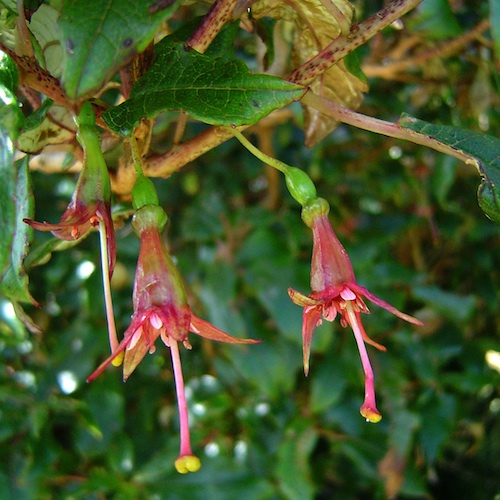
| Flowers of tree fuchsia, Fuchsia excorticata. |
.jpg) |
| Flowers and young fruits of mountain flax, Phormium cookianum. |
I was surprised to find in this paper evidence that
moa ate so many small alpine herbs and small fruits too. They might have been significant seed dispersers. This, like the Fuchsia flowers, suggests they might have been capable of choosing
tasty morsels.
A previous study by some of the same scientists (Wood et al. 2008) showed the
presence of a small buttercup, Ceratocephala
pungens, in moa coprolites from Otago. Ceratocephala is
tiny and seasonal. The plants are
ground-hugging rosettes at most a couple of centimetres across, and they grow in bare ground, yet their seeds
were found in coprolites from two species of moa. The genus is otherwise known only from Europe and W. Asia,
so when this new species was described from New Zealand, I entertained the
possibility that it might not be a native (Garnock-Jones 1984). Yet here it is, in coprolites produced
before humans arrived in New Zealand.
In the past, the deer-hunting lobby in New Zealand
has argued that introduced mammals were good for the environment because they replace these extinct
giant herbivorous birds. This
study suggests otherwise. Two very
palatable plants that were common in moa diet—Fuchsia and wineberry—are no longer found on the Garibaldi Range,
and many others are now confined to inaccessible cliffs and edges of sink-holes.
References.
Bond WJ, Lee WG, Craine JM (2004). Plant
structural defences against browsing birds: a legacy of New Zealand's extinct
moas. Oikos 104: 500–508.
Garnock-Jones PJ (1984). Ceratocephalus pungens (Ranunculaceae):
a new species from New Zealand. New Zealand Journal of Botany 22:
135–137 (Note the different spelling in this paper; the original spelling Ceratocephala is now preferred)
Greenwood RM, Atkinson IAE (1977). Evolution of divaricating plants in New Zealand
in relation to moa browsing. Proceedings of the New Zealand Ecological
Society 24: 21–33.
Wood JR, Rawlence NJ, Rogers GM, Austin JJ, Worthy TH, Cooper A (2008). Coprolite deposits reveal the diet and ecology of the extinct New Zealand megaherbivore moa (Aves, Dinornithiformes). Quaternary Science Reviews 27: 2593–2602.
Wood JR, Wilmshurst JM, Wagstaff SJ, Worthy TH, Rawlence NJ, & Cooper A (2012). High-Resolution Coproecology: Using Coprolites to Reconstruct the Habits and Habitats of New Zealand's Extinct Upland Moa (Megalapteryx didinus). PloS one, 7 (6) PMID: 22768206


.jpg)
.jpg)


g.jpg)


