Showing posts with label evolution. Show all posts

Tuesday, 28 January 2014

Wednesday Wildflower: tarweed

Tarweed is flowering at the moment.  Parentucellia viscosa is an erect herb with small yellow flowers and its leaves are covered with glandular hairs so dense they feel sticky to the touch.  You'll see it in damp patches beside roads and tracks, along the edges of ditches, and wet hollows in grassland.
Tarweed, Parentucellia viscosa, Karori, Wellington
It's a hemiparasite, which means it derives some of its nutrients parasitically from other plants, but it's also green and able to generate its own energy through photosynthesis.  Full parasites (holoparasites) usually lose the ability to photosynthesise and to make green pigments, so they are often brown or pale.

Tarweed flower.
It's related to Euphrasia, another genus of hemiparasites, of which we have a large number of native species in New Zealand, and to the introduced broomrape, Orobanche, which are holoparasites.

Orobanche minor, broomrape, near Nelson.
The hemiparasites Parentucellia and Euphrasia used to be classified along with Veronica in the family Scrophulariaceae, but it was discovered a decade or so ago ago that Scrophulariaceae as it was then drawn up wasn't a natural group (of related plants).  So that previously large family has been split up. Veronica was transferred to be classified with its relative Plantago (Plantaginaceae), and Parentucellia and Euphrasia joined their relatives the broomrapes in Orobanchaceae.

Ngaio, Myoporum laetum, Wellington
Although Scrophulariaceae has been dismembered into 7–10 different families to make a more natural classification, it still exists as a much smaller family, many of them African.  Our only native member is Myoporum, ngaio.

Saturday, 14 December 2013

The Great Veronica Hunt —Part 6.

I'm writing this in Melbourne, where I'm about to fly home after a wonderful three weeks in Australia. I wasn't specifically on a Veronica hunt, but kept my eyes open anyway, just in case.

I didn't see any Veronica in Queensland or around Sydney. The first I saw was the introduced V. arvensis in Bega, a small New South Wales town.  Australia has many of the same weedy speedwells that New Zealand does, so I was more interested to see plants of the indigenous species.
Mallacoota inlet, Vic.
We spent a couple of days with friends at Mallacoota in the far east of Victoria, and there came across V. plebeia growing beside a track in coastal forest in the wonderfully-named Croajingalong National Park.
Veronica plebeia, Mallacoota, Vic.
The flowers were closed just as they often are in New Zealand, needing a warm sunny day to open.  If they don't get to open, I assume they self-pollinate, because they always seem to set fruits.

The flower below was photographed on a cultivated plant in New Zealand, where V. plebeia is widespread and considered by some botanists to be native.  It is introduced and weedy in some other parts of the world though, so it does have the ability to be invasive.
Veronica plebeia, from a cultivated plant in New Zealand.
That was it for wild speedwells the whole trip, but my sister-in-law, near Ballarat, had some small plants of another Australian native, Veronica gracilis, ready to plant out in the garden, and one of these was in flower.
Veronica gracilis, cultivated near Ballarat, Vic.
The plants are strongly rhizomatous, and this one even had a shoot coming out of the drainage hole in the bottom of its pot.

Australia has 23 native species of Veronica, classified in section Labiatoides, and they are the sister group to the large New Zealand clade (section Hebe) that includes the hebes and their relatives (Albach & Briggs 2012).  Thus, although they look much more like northern speedwells than New Zealand hebes, they are known to be more closely related to the hebes.  And because of that fact, it's misleading to classify them as Veronica unless you classify our hebes in Veronica as well.

Reference


Albach, D; Briggs, BG. 2012. Phylogenetic analysis of Australian species of Veronica (V. section Labiatoides; Plantaginaceae). Australian Systematic Botany, 2012, 25, 353363
http://dx.doi.org/10.1071/SB12014

Tuesday, 12 November 2013

A new classification for the southern beeches.

ResearchBlogging.org
In New Zealand, the forest we typically identify with—the “bush”— is the lowland mixed conifer-angiosperm forest, with a canopy usually of angiosperm trees like tawa (Beilschmiedia tawa) or kamahi (Weinmannia racemosa) and large emergent conifers of the southern families Podocarpaceae (e.g., rimu, Dacrydium cupressinum) and Araucariaceae (i.e., kauri, Agathis australis).  But in most montane parts of the South Island (Te Wai Pounamu) and on often drier ridges and hill country of the North Island (Te Ika A Māui), a very different type of forest is dominant.  This forest comprises a uniform canopy of often a single species of southern beech.  Usually the forest doesn’t have a dense understory, giving an open and well-lit appearance to the interior.  This is just as much an iconic New Zealand forest as the “bush”, and one that’s familiar to many trampers.
Southern beech forest, Orongorongo Valley, near Wellington
Similar forests are found in the southern part of South America, so that travelers there from New Zealand often feel it’s just like home.  Southern beech forest also occurs in Australia, New Guinea and New Caledonia.  It’s known from fossils in Antarctica too, going back to the Cretaceous, as well as in many of the places where it still occurs today.

The southern beeches were originally classified in the genus Fagus, along with their northern namesakes, but by 1850 their differences had been recognised and they were transferred to the genus Nothofagus (the name means southern beech [correction, 21 Nov 2013: it means "false beech"; southern beech would be Notofagus.  H/T Rosi]).  As Nothofagus, the southern beeches have been important trees in New Zealand ecology, conservation, forestry, and biogeography.  Whole books have been written about them.  Nothofagus is currently reckoned to have about 40 species.  In 1962, a Russian botanist, Lyudmila Kuprianova, went a step further and proposed a new family, Nothofagaceae, for the southern beeches.  This took rather a while to be accepted.

Many botanists have wrestled with the relationships of the species within Nothofagus, using sometimes single or few characteristics, other times multiple ones.  The advents of (1) cladistic thinking (using explicit evolutionary trees) and (2) molecular characteristics from DNA sequencing have been of major help to this enterprise, because DNA has provided a wealth of new characters that are independent of the morphological ones and because the analysis and interpretation are out in the open for everyone to evaluate.  Pretty quickly, the understanding of relationships in the southern beeches has converged on a single well-supported arrangement, which was arranged into a classification by Australian botanists Bob Hill and Jenny Read, who recognised one genus (Nothofagus) with four subgenera.
Southern beech forest near Eastbourne, Wellington.
Beyond the southern beeches, DNA sequence data were also telling us a lot about the relationships of southern beeches to the oaks, beeches, chestnuts and she-oaks and it became pretty clear that Kuprianova was correct in isolating them in their own family.  It turns out that the ancestor of the beech order (Order Fagales) first divided into two species: one that was the common ancestor of the northern sweet chestnuts, beeches & oaks, she-oaks, myrtles, and more—seven families in all—and the other that was the common ancestor of just Nothofagus.  If you were to divide Fagales into two suborders, one would have seven families and many genera, the other would have just one family, and that family would have just one genus.  Thus Nothofagus and Nothofagaceae have different ranks (their place in the hierarchical classification) but identical circumscriptions (the species they contain); that redundancy means we're not using the available hierarchy of ranks to full advantage.

What’s more, the current classification of all the southern beeches in one genus Nothofagus can be a bit misleading.  Most biologists agree that it’s absolutely essential that every genus or family should contain closest relatives.  In other words, a species shouldn’t be more closely related to a member of another genus than it is to a species that’s classified in its own genus.  Nothofagus doesn’t break that rule: every species of Nothofagus is more closely related to every other species than it is to any species that’s not placed in Nothofagus.  So far, so good.

But it’s easy to assume that our New Zealand species—black, hard, red, mountain and silver beeches—might be each other’s nearest relatives, and often people are surprised to find that’s not the case.  In fact, hard, black, mountain, and red beeches are related, but silver beech’s nearest relative is in Australia.  Wouldn’t it be better if their classification and their scientific names could reflect that?

This week two New Zealand botanists, Peter Heenan and Rob Smissen from Landcare Research, have revisited the classification of the southern beeches (Heenan & Smissen 2013).  They brought together everything that’s been published so far, from both morphology and molecular systematics, and added some new data and analyses of their own.  Their findings are pretty much the same as several previous reports, but they can now place greater levels of confidence in the groups they recognise.  They comprehensively discuss alternative classifications and alternative criteria and come down with what I think is the most sensible classification. 

Nothfagaceae now contains four genera.
  • Nothofagus comprises just five species from temperate South America.  The rest of the family is no longer classified as Nothofagus.
  • Lophozonia is a reinstated genus, containing seven species from South America, New Zealand, and Australia.  
  • Fuscospora has six species and a very similar distribution; it’s a newly recognised genus, although like the others it has been treated as a subgenus in the past.  Additionally in Fuscospora, this paper promotes mountain beech to species rank as F. cliffortioides.  I look forward to reading the evidence for that change, because it was previously treated just as a variety of black beech.
  • Finally, Trisyngyne is the largest genus (25 species) and found today in the tropics: New Caledonia, Papua New Guinea and extending into Indonesia.  
These genera are strongly supported by both molecular, morphological, and chemical characteristics, and they have symbiotic fungi and parasitic fungi and insects that also seem to recognise their relationships.
Red beech, Fuscospora fusca.
Black beech, Fuscospora solandri.
Mountain beech, Fuscospora cliffortioides, near Cass, Canterbury.
Hard beech, Fuscospora truncata
Silver beech, Lophozonia menziesii.
When we use these new names for the New Zealand plants, we see immediately that we have two natural groups represented here: Fuscospora and Lophozonia.  New Zealand no longer has any species of Nothofagus.
Red beech, Fuscospora fusca, Tunnel Gully near Wellington.
A final word of a more general nature.  Some people will want to reject this change, perhaps because they feel nostalgic about the name Nothofagus, or perhaps because they feel name changes are disruptive.  But taxonomy is science and there are scientific criteria involved.  Like climate change, evolution, and vaccination, you can’t simply reject sound science because you don’t like it.  
Silver beech, Lophozonia menziesii, Haast Pass.
It’s very rare in science for there to be two equally well-supported positions such that users are free to choose whichever one they prefer.  Rather, scientists make decisions after critically considering the evidence.  It's true a classification is a human construct, but it's based on facts about evolutionary history.  Those facts are hard-won data from the field, herbarium, and genetics lab.  If your opinion contradicts those facts, then you're at risk of denying the science.

In this case however, both the old classification and the new one do pass the most important test, that of classifying related species together, so we can't rule out one or the other on that ground.  The question here is, "what's the appropriate rank for these four well-supported groups?"  But is one answer better than the other?  Heenan and Smissen argue strongly and in detail that there are good reasons to prefer their new scheme over the old one.  For instance, they show that the newly-recognised genera are at least as old, diverse, and distinct as established genera in the other families of the order, that the new names are more informative about relationships among the southern beeches, and that a redundant grouping has now been eliminated.  They conclude, and I agree, that these benefits far outweigh the temporary disruption of having new names to learn.
An Australian beech, Lophozonia moorei, growing at Eastwoodhill.

Heenan, P.B.; Smissen, R.D. (2013). Revised circumscription of Nothofagus and recognition of the segregate genera Fuscospora, Lophozonia, and Trisyngyne (Nothofagaceae) Phytotaxa, 146 DOI: 10.11646/phytotaxa.146.1.1

Wednesday, 15 May 2013

Wednesday wildflower: Red carpet, brown carpet

When I use the term wildflower, it's often to avoid the judgmental term "weed".  I like most plants, and if other people have species they don't like, well, that doesn't necessarily stop me enjoying them.  Furthermore, plants we designate as weeds are often biologically very interesting.  To a botanist, the term "weediness" has an ecological meaning that signifies more than a nuisance plant.

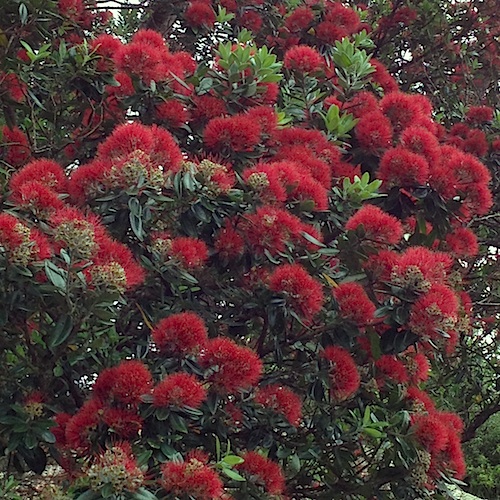
Pōhutukawa flowers
One of the interesting things weeds do well is reproduce.  All that any plant or animal needs to do is to reproduce itself at least once, but because an outcrossing sexual plant or animal contributes only one of its two sets of genes to each offspring it must do it twice to break even.  Even then, reproducing a few times doesn't guarantee the survival of all your genetic material, because which copies of genes get into a sperm or egg is random.  But some plants seem to reproduce in overdrive.

Weeds often succeed because they out-reproduce other plants.  Some are long-lived and may spread vegetatively, but others produce huge numbers of seeds.

A few red stamens have accumulated in the gutter beneath these trees, but sometimes, if it's not windy, a thick red carpet can build up.
Today's wildflower is a weed in the biological sense, but to New Zealanders it's a much-loved native flowering tree, the pōhutukawa, Metrosideros excelsa.  Pōhutukawa puts a lot of effort into reproduction, and that's probably why it's an unwanted weed in some other parts of the world where it has been introduced as an ornamental, like South Africa and Hawai'i.  Some people also consider it a weed in parts of New Zealand that are outside of its native range, such as Wellington, because it's invasive and aggressive there too.

A cluster of pōhutukawa flowers; each individual flower has about 25 red stamens (with yellow anthers) and one red style.
Pōhutukawa reproduction seems wasteful.  The trees flower profusely around Christmas time in New Zealand and in the later part of each flower's life the bright red stamens fall to the ground where they can form a thick red carpet.  This isn't over-production particularly; it's just that the red stamens are so visible and there are so many flowers producing them.  They can be dispensed with once their pollen has been dispersed.  They're visible for a good reason: pōhutukawa is primarily pollinated by birds (tūī, bellbirds, but also silvereyes and starlings) and the red colour attracts them because birds see well in the red wavelengths.

A bit later in the summer, many of the old flowers themselves fall.  I guess these are flowers that aren't setting seed; they no longer have a function and the plant can discard them.  I don't know whether these are functionally male flowers or simply flowers that didn't get pollinated, but these form a pale grey-green carpet for a time.

Pōhutukawa seeds in the gutter, Kelburn, Wellington
The third big dump of reproductive material is happening about now in Wellington, and that's the dispersal of seeds in their millions.  Most of these are never going to germinate.  They pile up in gutters, on footpaths, and at the bases of walls.  I'd like to do a rough calculation of the weight of stamens, aborted flowers, and seeds produced by a large pōhutukawa tree in a season; I think we'd all be surprised.  Multiply that, whatever it is, by the number of trees in Wellington and that's a lot of biomass falling to the ground each year.

Pōhutukawa seeds.
This prodigious reproductive effort is one of the attributes that makes pōhutukawa such a successful plant, and it's a trait normally associated with weediness.  No wonder then that our Christmas tree has become a pest in places.

Friday, 28 September 2012

Experimental taxonomy at home.

Ernst Mayr pioneered the biological species concept, an idea that brought taxonomy of species into line with population genetics and evolution.  The idea is that a species is defined by the genetic relationships among its members; they’re all part of one big potentially-interbreeding population.  In Linnaeus’s day people sought to classify species based on what they looked like, rather than who they could breed with.
Using appearance is a pretty good proxy for the ability to interbreed, and much of the time it’s what taxonomists still do, simply because doing the breeding experiments or measuring genetic relationships among individuals is just too time-consuming.
But there are two classes of concerns that arise.
On one hand, individuals belonging to the same species can look very different.

Sometimes juveniles are hugely different from adults, like caterpillar and butterfly, elva and eel, or juvenile vs adult lancewood.  In a New Zealand plant example, Jim Le Comte and Colin Webb (Le Comte & Webb 1981) showed experimentally that the speargrass Aciphylla townsonii is actually the juvenile form of A. hookeri.  Different juveniles seem to be a feature of New Zealand plants, but they're common elsewhere too.
Juvenile (left) and adult foliage of mataī (Prumnopitys taxifolia)
 Secondly, small genetic differences can lead to quite big visible differences in plants or animals that belong to the same species.  Some of these are simple polymorphisms, like eye colour in humans.  In Veronica amplexicaulis, a hairy form used to be distinguished as a separate species (Garnock-Jones & Molloy 1983, under the old name Hebe amplexicaulis).  But it turns out this difference is the product of two alleles of a single gene, as are occasional flower colour variants in many plants.
White and blue viper's bugloss, Echium vulgare, growing side by side (Black Birch Range, Marlborough).
Thirdly, local populations might adapt to special conditions.  On mine tailings, where toxic heavy metals pollute the soil, plants may acquire tolerance, and this could involve some differences in form or in underlying physiology, yet they still freely mate with the non-tolerant individuals nearby.  These are classified as ecotypes, but not as separate species.  The differences are maintained by strong selection, even in spite of free gene flow between the tolerant and intolerant plants.
The form of Veronica albicans that grows on the dolomite outcrop at Mt Burnett looks a little different from other populations of this variable species; it might have adapted to its substrate, yet there's no evidence that it can't exchange genes with the rest of its species.
 Fourthly, some plants and animals are able to alter their form to cope with different environments they find themselves in or to escape predators—phenotypic plasticity or polyphenism.  Some inchworm caterpillars develop different appearances to blend in with the foliage of whatever host plants they’re living on (Greene 1989).  The underwater and aerial leaves of aquatic plants can be hugely different.  Plants can have very different leaf shapes, or even leaf anatomy, depending on the amount of sunlight they’re receiving or even what season they’re in.
Eryngium vesiculosum has very different leaves in summer (above) and winter (Webb 1984).
In all four of these situations, the result is two different looking plants growing together side by side, giving the appearance of two distinct species that aren’t interbreeding.  That’s just the sort of thing that gets taxonomists and field botanists excited, because we always like to discover a new species.
On the other hand, the reverse situation can arise.  Two species can look so similar that their existence isn’t even suspected until genetic tests are done.  These are called cryptic species.
It’s important to be aware of these possibilities, and in fact to rule them out as explanations before jumping to the conclusion that the variation we’re observing is due to the existence of more than one species.  The idea that two different-looking plants growing side by side must be different species is simplistic, yet "side by side" has become a bit of a mantra in some circles.
One way to test these potential new species is by growing different-looking plants together in uniform environments—common garden experiments—and also growing genetically identical plants in different environments—reciprocal clone transplants.  These approaches were pioneered in the first half of last century by Swedish botanist Turesson and by American botanists Clausen, Keck, & Hiesey.
Veronica lanceolata in flower, Rimutaka Range.
The speedwell hebe Veronica lanceolata is widespread in the North Island of New Zealand and a few parts of the South Island.  Each region has its own form of the species and, in general, adjacent populations are quite similar.  With some familiarity, it’s possible to tell from its appearance where a plant has come from.  These differences are maintained in common garden experiments, but I don’t regard these forms as different species because they can cross freely, their flowers and fruits are very similar, the differences are quantitative rather than qualitative, they have the same chromosome number, and the changes are mostly gradual and continuous from place to place.
Each leaf is from a different population of Veronica lanceolata.
However, there are places where two very different-looking forms grow together side by side, and this is exactly the sort of situation where a simplistic "side by side" approach might lead a botanist to the view that two species are involved.  In the Ruahine and Kaimanawa Ranges, especially on limestone cliffs, there are low-growing small leaved plants growing together with bushier large-leaved plants.  Although their leaves and stems are different in size and stature, their flowers and fruits are the same, which is a bit of a clue that these plants are responding in a plastic way to their environments, that there are no underlying genetic differences, and no breeding barriers between them.  I’d always assumed so at any rate, even though some field botanists made numerous collections of both forms, mounted them as separate accessions, and labelled them to highlight the differences and the fact they grew together side by side.  The hint was implicit: these might be different species.  Perhaps fortunately, nobody had the confidence in their hunch to give them different names.
South end of the Maungaharuru Range.
A couple of summers ago I was in the Maungaharuru Range in central Hawkes Bay with my colleague Heidi Meudt from Te Papa.  We were looking for forget-me-nots along the tops for a detailed genetic study she's conducting into their taxonomy and evolution.  Along the cliffs at the south end of the range we found Veronica lanceolata growing in mostly shady sites among mosses and algae.  But when we stumbled into some sink-holes things got interesting.  Here were moist shady sites with quite large-leaved plants, very close to sunny outcrops with tiny creeping plants.  It was an ideal opportunity to test my hunch that these were just plastic responses to moisture and shade.


There wasn’t room in the garden at home for a large randomised trial, so I sampled just a couple of plants of each type from sites only a few metres apart, and brought them home to grow in pots.  I also pressed branches of each, to record and preserve how they had looked in the wild.
Collection 2834, small and large leaved plants just after potting, Feb 2011.

Collection 2836, a small leaved plant just after potting, Feb 2011. The white plastic labels are 13 mm wide.
They’ve been growing now for about 18 months, and some, but not all, of the changes are quite dramatic.  For 2384, the small-leaved plant now has somewhat bigger leaves, but it's still distinctly smaller than the large-leaved plants.  For 2836, leaves are now up to 20 mm long, whereas they were about 5 mm before.
Both surfaces of the largest leaves from each of the three plants (two from 2836 small), Sep 2012.
So the results are a bit mixed, and this shows how important it is to use large samples, not just a couple of plants, and to randomise the trial properly.  The plants have exhibited some phenotypic plasticity but that doesn't account for all the differences.  Note also the two very different leaf shapes from the same plant of 2836: more evidence of plasticity.  Maybe both phenotypic plasticity and ecotypic differentiation are happening in this population.  Next time I'm in a position to collect a bigger sample and repeat this experiment I will do so.  In the meantime, I can try crossing the small- and big-leaved plants this summer.  My expectation is the offspring will be fully fertile.
With these speedwell hebes, the differences in growth form and leaf shape are striking, but they aren’t sufficient to compel rejection of the hypothesis that they’re the same species, because there are two different and simpler explanations—phenotypic plasticity and ecotypic differentiation—for that pattern.  My simple experiment hasn't clearly demonstrated which is happening, because the experimental design and sampling are insufficient.  But it's important to note also that these are quantitative differences—leaf shape and size—just the sorts of things that often vary in natural populations.
I'm sure it’s possible to test species status scientifically and explicitly.  That means starting with a testable hypothesis.  It’s better to start with the hypothesis that the two entities are conspecific, because any differences are evidence to the contrary that would compel us to reject the hypothesis.  If instead we start with the hypothesis that they’re different species, it’s hard to imagine how many similarities between them would compel us to reject that idea.  And if we start with the hypothesis that there are two species, and then seek evidence to support the hypothesis, then we're not doing science, at least not as it was formulated by Karl Popper.
References

Garnock-Jones, P.J.; Molloy, B.P.J. 1983.  Polymorphism and the taxonomic status of the
Hebe amplexicaulis complex (Scrophulariaceae).  New Zealand Journal of Botany 20: 391–399.

Greene, E. 1989. A diet-induced developmental polymorphism in a caterpillar. Science 243: 643-646.

Le Comte, J.R.; Webb, C.J. 1981.   Aciphylla townsonii — a juvenile form of A. hookeri (Umbelliferae).  New Zealand Journal of Botany 19: 187–191.

Webb, C.J. 1984.  Heterophylly in Eryngium vesiculosum (Umbelliferae). New Zealand Journal of Botany 22: 29–33.

Monday, 16 July 2012

Going through the motions: what did moa eat?


ResearchBlogging.orgMoa were giant flightless birds found in New Zealand (the plural of moa is moa, because the Māori language doesn’t distinguish singular from plural nouns, with one exception).  There were 6 genera and 9 species of moa; the largest, Dinornis, stood well over 2m tall.  They’ve been extinct since shortly after Māori arrived here.  It’s thought they were an easily harvested source of protein and were quickly driven to extinction.  Although everywhere on earth where humans live has extinct megafauna (e.g., aurochs in Europe, giant sloths in South America, giant lizards and kangaroos in Australia), in most places the extinctions happened so long ago that they're very hard to study.  But in New Zealand, the extinction of moa is quite recent, dating from around the 13th century, and there are still traces to be found and studied.  Deposits of regurgitated gizzard stones are sometimes found, and subfossil birds can be recovered from caves.  It's thought that some large trees still alive today might have been dispersed as seeds by moa.  
About 35 years ago, Michael Greenwood and Ian Atkinson (Greenwood & Atkinson 1977) proposed that moa could have been a major influence on growth forms of New Zealand plants.  In particular, they suggested the twiggy wiry tangled small-leaved growth forms that we call divaricating shrubs could have evolved as a defense against moa browsing.  That’s been a very popular and appealing idea, but one that’s had its critics.  While New Zealand botanists have been happy to attribute our unusual flowers to pollination by our depauperate and unspecialised pollinator fauna and our prevalence of small fleshy fruits to dispersal by frugivorous birds, many have been wary of accepting the moa browse hypothesis.
A divaricating shrub, Coprosma cuneata, Campbell Island.
Partly their objections have arisen from concern that these ideas can’t directly be tested, because moa are no longer with us.  Nevertheless, many other purely historical ideas in biology can be tested, by indirect methods at least.  Greenwood & Atkinson’s seminal paper has spawned an industry in New Zealand ecology largely driven by questions about the likely selection pressures of moa on New Zealand plants.  One recent test of moa browsing was a cafeteria experiment (Bond et al. 2004), where two other large ratite birds—emus and ostriches—were offered related pairs of divaricating and non-divaricating plants.  The birds stripped the non-divaricating plants in short order, but had trouble pulling the springy and wiry stems of the divaricates and manipulating the twigs and small leaves in their beaks. 
Another very successful research strategy is coproecology, the gleaning of evidence from fossil droppings, coprolites.  The most recent paper (Wood et al. 2012) by the moa coproecologists has received a lot of press attention because it showed for the first time that moa fed on flowers, as well as on fruits, leaves, and twigs.
The scientists found a pile of poo just inside the entrance of a cave in the Garibaldi Range, South Island mountains.  Dried in sunshine and breezes, but protected from rain, these droppings had lain undisturbed for hundreds to thousands of years.  Taking great pains to avoid contamination, the scientists sampled 35 of the coprolites, collecting DNA to identify the species of moa as well as plant species eaten, macrofossils (seeds, leaves, etc.), microfossils (pollen grains), and measuring organic content of the dung.  They also used radiocarbon dating to estimate when the droppings were dropped.
The dung was all from one moa species, the upland moa (Megalapteryx didinus), a stout bird that stood about 1m tall at the rump.  The oldest droppings were dated from about 6,300 years ago, and the youngest from a bit less than 700 years ago, so they span a good proportion of the time from the last ice retreat to the final extinction of moa.  Interestingly, several of the droppings had identical ages and plant contents and are thought to have been deposited in the same "defecation event". 
The three methods of sampling plant remains (the authors refer to these as proxies) in the droppings—pollen, macrofossils, and DNA— were complimentary.  Of these, pollen could be contamination from outside, especially when it comes from wind-pollinated trees that flower largely out of reach of moa, like Nothofagus (southern beech) or from plants that are highly poisonous, like wind-pollinated Coriaria.  The plot below, from the paper, relates pollen abundance in the coprolites to abundance in the environment; plants above the null distribution line are the ones likely to have been part of the moas' diet.


A range of montane and subalpine plants were found, some (southern beech, buttercups, sedges, grasses and Fuchsia) in all three proxies.  The results show moa were generalists, eating pretty much everything, and they ranged across all the available habitats, as the figure below demonstrates.  


But only a few of the eaten plants might be divaricating shrubs.  These include Myrsine and Coprosma, for which the DNA and pollen evidence can't distinguish if the plants eaten were divaricating or not, and Neomyrtus, which is divaricating.
A divaricating Myrsine, M. divaricata.
A non-divaricating Coprosma, C. foetidissima.
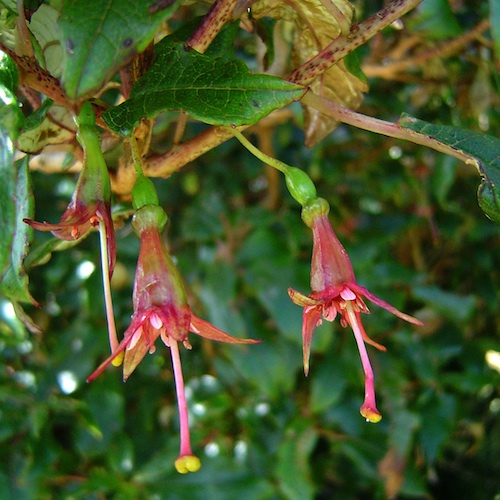
The finding of pollen from bird-pollinated flowers—Phormium and Fuchsia—is especially interesting.  These produce quite large amounts of sweet nectar and are pollinated by birds that are much smaller than moa, such as bellbirds and tūī.  Yet their pollen is not likely to have got into coprolites other than by passing through the gut of the moa.  The authors aren't suggesting moa were pollinating the flowers, rather that they were eating them.  The large fleshy flower stalks of Phormium are probably quite nutritious and the nectar from a single flower is a small but sweet treat for a human.  On the other hand, Fuchsia flowers are produced singly or in small clusters on the twigs or bare trunks of the trees, and it must be quite finicky work to pick these one at a time; they hardly look worth the effort for a large hungry bird.  If moa had a taste for sweet nectar such that they were a threat to flowers, could their grazing have driven the evolution of tall scapes in Phormium and the tree habit in Fuchsia excorticata?  The controversy lives on.
Flowers of tree fuchsia, Fuchsia excorticata.
Flowers and young fruits of mountain flax, Phormium cookianum.
I was surprised to find in this paper evidence that moa ate so many small alpine herbs and small fruits too.  They might have been significant seed dispersers.  This, like the Fuchsia flowers, suggests they might have been capable of choosing tasty morsels.
A previous study by some of the same scientists (Wood et al. 2008) showed the presence of a small buttercup, Ceratocephala pungens, in moa coprolites from Otago.  Ceratocephala is tiny and seasonal.  The plants are ground-hugging rosettes at most a couple of centimetres across, and they grow in bare ground, yet their seeds were found in coprolites from two species of moa.  The genus is otherwise known only from Europe and W. Asia, so when this new species was described from New Zealand, I entertained the possibility that it might not be a native (Garnock-Jones 1984).  Yet here it is, in coprolites produced before humans arrived in New Zealand.
In the past, the deer-hunting lobby in New Zealand has argued that introduced mammals were good for the environment because they replace these extinct giant herbivorous birds.  This study suggests otherwise.  Two very palatable plants that were common in moa diet—Fuchsia and wineberry—are no longer found on the Garibaldi Range, and many others are now confined to inaccessible cliffs and edges of sink-holes.


References.


Bond WJ, Lee WG, Craine JM (2004). Plant structural defences against browsing birds: a legacy of New Zealand's extinct moas. Oikos 104: 500–508.

Garnock-Jones PJ (1984). Ceratocephalus pungens (Ranunculaceae): a new species from New Zealand.  New Zealand Journal of Botany 22: 135–137 (Note the different spelling in this paper; the original spelling Ceratocephala is now preferred)

Greenwood RM, Atkinson IAE (1977). Evolution of divaricating plants in New Zealand in relation to moa browsing. Proceedings of the New Zealand Ecological Society 24: 21–33.

Wood JR, Rawlence NJ, Rogers GM, Austin JJ, Worthy TH, Cooper A (2008). Coprolite deposits reveal the diet and ecology of the extinct New Zealand megaherbivore moa (Aves, Dinornithiformes).  Quaternary Science Reviews 27: 2593–2602.

Wood JR, Wilmshurst JM, Wagstaff SJ, Worthy TH, Rawlence NJ, & Cooper A (2012). High-Resolution Coproecology: Using Coprolites to Reconstruct the Habits and Habitats of New Zealand's Extinct Upland Moa (Megalapteryx didinus). PloS one, 7 (6) PMID: 22768206

Wednesday, 25 April 2012

Sperm racing: the tortoise and the hare.

ResearchBlogging.org
When I explain plant evolution, I often use vertebrate evolution as an analogy for some of the key innovations that happened in land plants.  Like the land vertebrates' ancestors (fish), the ancestors of land plants lived in water (they were green algae).  Once they conquered the land, the earliest land plants (the bryophytes) were like the amphibians: they can live on dry land, but they need water for mating.  The seed plants acquired a kind of internal fertilization, because they use pollen grains to deliver their sperms right to the stigma or the ovule, where a pollen tube can take it the last few millimetres to the egg.  In this, the seed plants resemble the mammals.  However I take pains to stress that this is an analogy.  These plants are doing similar things to the animals for similar reasons, but in completely different ways.
Bryophytes are rather simple small plants that tend to grow in damp places.  There are three main groups: mosses, liverworts, and hornworts.  Mosses are probably the most familiar, because they're common on damp banks and in shady lawns.
A moss (Leptostomum inclinans), liverwort (Aneura sp.) and hornwort (Phaeoceros carolinianus).
When you look at mosses, it's easy to get the impression that they're delicate and don't stand up well to environmental stress.  They live in the shade and damp, and they have a range of adaptations that protect them from drying out.  These include a dense felt of rhizoids that trap water against the stems, small overlapping leaves, sometimes able to curl up to prevent drying, and fine hair-points to the leaves that cut down drying wind flow over the cushion.
But if you thought mosses were the weaklings of the plant world, you'd be wrong.  They can be tough, and some can be completely dried down and yet can still revive when wetted.  One of the easy ways to grow mosses is to dry them out, grind them into a powder, and sow the dry dust into a damp plant pot.  The cells will rehydrate and start to grow new moss plants.  They do this by protecting the internal structures of their cells from irreversible damage when they are dried, or by having mechanisms for quick recovery once they're rehydrated. 
Leucobryum candidum, a common forest floor moss in New Zealand.
Their weak point has always been seen as the stage in the life cycle when mating takes place.  Algae mate under water; they can shed their sperms into the water to swim off in search of eggs.  Seed plant sperms are protected from drying inside the pollen grain or the pollen tube.  But moss sperms must live in a surface film of water in a damp moss cushion, or run the gauntlet of a short shower of rain.  They're not released until there's significant water present and the assumption has always been that the vulnerable sperm cells are short-lived and must swim to an egg quickly.  They must achieve fertilization, or soon die trying as conditions dry out.
Now Sarah Eppley of Portland State University, her graduate student Erin Shortlidge, and PSU plant physiology professor Todd Rosenstiel have looked at the tolerance of moss sperm to the stress of drying out (Shortlidge et al. 2012), and we'll have to change the way we look at mosses.  They set up some experiments using the sperms of three common mosses, Bryum argenteum, Campylopus introflexus, and Ceratodon purpureus.
Bryum argenteum, Campylopus introflexus, Ceratodon purpureus (from Malcolm et al. 2009, with permission)
After sampling the plants in wild populations, they established cultivated populations under uniform conditions.  They learned to recognise the male structures (antheridia) and find out when each antheridium was ready to release its sperms.   
In some mosses the male structures, antheridia, are clustered in hundreds at the tips of the branches (Bill Malcolm, photo)
They could use this knowledge to collect and purify sperms from the moss plants for their experiments.  Using different dry-down rates and different lengths of time for drying and before rehydration, they were able to measure the sperms' tolerance to desiccation by looking for tell-tale signs of cellular damage.  The results show that in all populations of all three species, a similar proportion of sperms can survive desiccation and rehydration.  Usually, it's about one in five or one in six sperms that survive.  It doesn't make a lot of difference how quickly they're dried, although there was more variability in the slowly-dried samples.
Tufts of silvery Bryum argenteum, growing with Syntrichia sp.
In plants and animals that can survive almost total dehydration, one of the commonest ways to protect the cell structures from damage is by using sugars.  Trehalose is a sugar that's protective, especially in animals like brine shrimps or in fungi.  Shortlidge et al. (2012) added sucrose, another sugar that's common in bryophytes, to some treatments to see if it made a difference.  That's interesting too, because sucrose and other simple sugars are used by the female moss as a chemical trail that sperms use to find their way to the eggs, so if sucrose helps, maybe the females are helping the sperms not only to find their way, but to survive their journey.
Moss sperms approach the neck of a female archegonium (from Iowa State University)
If sugar was added at the time of rehydration of dried sperm, the result was no different from the control (where no sugar was added); it didn't enhance protection.  But if extra sugar was present during the earlier drying-down phase, a higher proportion of sperms recovered.  Also, more sperms recovered in higher doses of added sugar than in lower doses.  This suggests the sugar helped protect the cells from damaging effects of drying, but its presence in cells during the recovery stages perhaps made little difference.
This research is interesting because it shows mosses aren't as fragile and vulnerable as we might have thought, even at mating time.  It also suggests some interesting possibilities to study evolution and natural selection at the time of moss mating.  If individual mosses have variable sperm, and this paper suggests they do, why would they produce some vulnerable sperms and some tough and resistant ones?  In animals, it's been shown that there's a tradeoff between vulnerability and life span, so if there's a race among sperms to fertilise an egg, it'd be an advantage to have fast, but vulnerable sperms (like the hare in the old story of the tortoise and the hare).  But if plants are far apart, weather is unpredictable, or there's little competition among sperm donor mosses, then having slow long-lived sperm (like the tortoise) might be an advantage.  It seems mosses might be hedging their bets by producing both kinds at once.
But hang on a minute!  If you've studied the moss life cycle, you'll remember that the moss plant is a haploid with one set of chromosomes.  Its sperms are formed by mitosis, not meiosis as in animal sperm.  That means all its sperms are genetically the same, so how can they vary in physiology?  One way might be that although the dividing cells get identical nuclei, there might be differences in the cytoplasm or in mitochondrial activity.  In animals, it's been shown that sperm can help each other by offering co-protection, helping siblings to complete, and helping each other to move in water.  If that's the case in mosses, it makes absolute sense for a sperm to sacrifice itself for a genetically identical sperm from the same plant, because it's as closely related to its sibling's offspring as it would be to its own offspring.
About 60% of mosses, like this Polytrichadelphus magellanicus, have separate male (right) and female (left) plants (not to the same scale).
Although mosses are simple plants, their sex lives are only now coming to be understood, and they're increasingly becoming used as models for studying general ideas about the evolution of reproductive biology.
REFERENCES

Malcolm, B., Malcolm, N., Shevock, J., & Norris, D. (2009).  California Mosses.  Micro-Optics Press.
Shortlidge, E., Rosenstiel, T., & Eppley, S. (2012). Tolerance to environmental desiccation in moss sperm New Phytologist, 194 (3), 741-750 DOI: 10.1111/j.1469-8137.2012.04106.x