Showing posts with label pollination. Show all posts

Saturday, 14 December 2013

The Great Veronica Hunt —Part 6.

I'm writing this in Melbourne, where I'm about to fly home after a wonderful three weeks in Australia. I wasn't specifically on a Veronica hunt, but kept my eyes open anyway, just in case.

I didn't see any Veronica in Queensland or around Sydney. The first I saw was the introduced V. arvensis in Bega, a small New South Wales town.  Australia has many of the same weedy speedwells that New Zealand does, so I was more interested to see plants of the indigenous species.
Mallacoota inlet, Vic.
We spent a couple of days with friends at Mallacoota in the far east of Victoria, and there came across V. plebeia growing beside a track in coastal forest in the wonderfully-named Croajingalong National Park.
Veronica plebeia, Mallacoota, Vic.
The flowers were closed just as they often are in New Zealand, needing a warm sunny day to open.  If they don't get to open, I assume they self-pollinate, because they always seem to set fruits.

The flower below was photographed on a cultivated plant in New Zealand, where V. plebeia is widespread and considered by some botanists to be native.  It is introduced and weedy in some other parts of the world though, so it does have the ability to be invasive.
Veronica plebeia, from a cultivated plant in New Zealand.
That was it for wild speedwells the whole trip, but my sister-in-law, near Ballarat, had some small plants of another Australian native, Veronica gracilis, ready to plant out in the garden, and one of these was in flower.
Veronica gracilis, cultivated near Ballarat, Vic.
The plants are strongly rhizomatous, and this one even had a shoot coming out of the drainage hole in the bottom of its pot.

Australia has 23 native species of Veronica, classified in section Labiatoides, and they are the sister group to the large New Zealand clade (section Hebe) that includes the hebes and their relatives (Albach & Briggs 2012).  Thus, although they look much more like northern speedwells than New Zealand hebes, they are known to be more closely related to the hebes.  And because of that fact, it's misleading to classify them as Veronica unless you classify our hebes in Veronica as well.

Reference


Albach, D; Briggs, BG. 2012. Phylogenetic analysis of Australian species of Veronica (V. section Labiatoides; Plantaginaceae). Australian Systematic Botany, 2012, 25, 353363
http://dx.doi.org/10.1071/SB12014

Tuesday, 3 September 2013

Wednesday wildflower: Veronica hederifolia

Last week I was at Lincoln, near Christchurch, working in the herbarium at Landcare Research.  I was checking my descriptions and identifying specimens towards my Veronica treatment for the new on line Flora of New Zealand, the eFlora.
Veronica hederifolia growing at the foot of an oak tree in the Liffey Domain, Lincoln.
One of the introduced species (there are about 20 of them) that I hadn't yet seen grows right there in Lincoln, so it seemed a good opportunity for a field trip to collect and photograph it.  Veronica hederifolia plants are soft annual herbs that creep along the ground.  Their flowers appear to be solitary in the axils of the upper leaves, but that depends on an interpretation.  Leaves that don't produce flowers are opposite, but there's a shift to alternate leaves, each of which has a flower in its axil.  It's probably reasonable as an alternative interpretation to consider this to be the initiation of a terminal inflorescence. In any case the leaf form doesn't change, whereas in many Veronica the flowers are produced in the axils of much smaller and simpler leaves, which are designated as bracts.
Veronica hederifolia growth form.
V. hederifolia has been growing there in Lincoln along the banks of the L2 river for over 50 years.  The botanist who collected it last—in 1985—was able to tell me exactly where to look, and there it was. There's one other collection in Landcare's herbarium, from St Mary's College grounds in Christchurch, and the Flora refers to other verified locations in Hawke's Bay, Manawatu, and Southland.

Although V. hederifolia looks a bit like V. persica in the way it grows, there are a lot of clear differences.  The leaf shape for one, but also the flowers are smaller, and the anthers are held right against the stigma so it self-pollinates, in spite of producing lots of nectar.  The fruits of V. hederifolia are hairless, circular, and barely notched, whereas fruits of V. persica are hairy along the edges of two widely diverging lobes.
Veronica hederifolia flower.
The calyx lobes are folded length-wise and have long hairs along their edges.
Veronica hederifolia, calyx.
I've taken a few small plants to try to grow it on at home, but annuals can be hard to transplant, so I'm hoping fruits and seeds will be ready when I go back to Lincoln next month.  Then I'll be able to finish my description by describing fruits and seeds and bring home some seeds to grow in the garden.

Monday, 15 July 2013

Wednesday wildflower: winter heliotrope

Winter heliotrope isn't a true heliotrope, but a daisy, related to the senecios I've featured in a few other entries in this series (here and here).  But it is both a wildflower and a weed, a garden plant that has escaped.
Winter heliotrope, Petasites fragrans.

This patch was in Aro Valley, an old-established part of Wellington, originally working class but now a mix of gentrified old cottages and student flats, arty cafes and boutiques.  The plants were in a garden that had a rather wild appearance; I'm sure its owner was deliberately aiming for a wilderness look.
Winter heliotrope flower heads.

The flowers are pink, instead of the usual yellow for this tribe of daisies (Tribe Senecioneae, characterised by the involucral bracts being in a single row, not in overlapping rows like roof shingles).  Winter heliotrope is dioecious (has separate male and female plants), but all the plants in New Zealand are males.  Their outer ray florets are all sterile (they make neither pollen nor seeds); ray florets are female in most daisies (the general structure of daisy flower heads is explained here).  The inner disk florets are male (often hermaphrodite in other daisies).  Not being able to have sex doesn't deter this plant a bit, because it is able to spread vegetatively, and of course people deliberately and inadvertently help that process.

You might note the stigmas in these florets, the large white somewhat feathery things poking through the tube of purple anthers in the centre of these florets.  How come male florets have such a large stigma?  In this and several other families, the pollen is presented on the stigma, so even though the florets are male, they still need well-developed female parts for pollen dissemination.  In a hermaphrodite daisy floret, the stigma opens after the pollen has gone to expose the two receptive surfaces.  I didn't examine these closely at the time, but in the photo I can't see any that have opened.

Wednesday, 15 May 2013

Wednesday wildflower: Red carpet, brown carpet

When I use the term wildflower, it's often to avoid the judgmental term "weed".  I like most plants, and if other people have species they don't like, well, that doesn't necessarily stop me enjoying them.  Furthermore, plants we designate as weeds are often biologically very interesting.  To a botanist, the term "weediness" has an ecological meaning that signifies more than a nuisance plant.

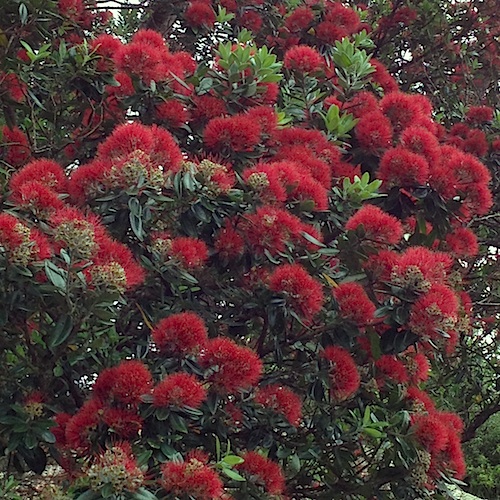
Pōhutukawa flowers
One of the interesting things weeds do well is reproduce.  All that any plant or animal needs to do is to reproduce itself at least once, but because an outcrossing sexual plant or animal contributes only one of its two sets of genes to each offspring it must do it twice to break even.  Even then, reproducing a few times doesn't guarantee the survival of all your genetic material, because which copies of genes get into a sperm or egg is random.  But some plants seem to reproduce in overdrive.

Weeds often succeed because they out-reproduce other plants.  Some are long-lived and may spread vegetatively, but others produce huge numbers of seeds.

A few red stamens have accumulated in the gutter beneath these trees, but sometimes, if it's not windy, a thick red carpet can build up.
Today's wildflower is a weed in the biological sense, but to New Zealanders it's a much-loved native flowering tree, the pōhutukawa, Metrosideros excelsa.  Pōhutukawa puts a lot of effort into reproduction, and that's probably why it's an unwanted weed in some other parts of the world where it has been introduced as an ornamental, like South Africa and Hawai'i.  Some people also consider it a weed in parts of New Zealand that are outside of its native range, such as Wellington, because it's invasive and aggressive there too.

A cluster of pōhutukawa flowers; each individual flower has about 25 red stamens (with yellow anthers) and one red style.
Pōhutukawa reproduction seems wasteful.  The trees flower profusely around Christmas time in New Zealand and in the later part of each flower's life the bright red stamens fall to the ground where they can form a thick red carpet.  This isn't over-production particularly; it's just that the red stamens are so visible and there are so many flowers producing them.  They can be dispensed with once their pollen has been dispersed.  They're visible for a good reason: pōhutukawa is primarily pollinated by birds (tūī, bellbirds, but also silvereyes and starlings) and the red colour attracts them because birds see well in the red wavelengths.

A bit later in the summer, many of the old flowers themselves fall.  I guess these are flowers that aren't setting seed; they no longer have a function and the plant can discard them.  I don't know whether these are functionally male flowers or simply flowers that didn't get pollinated, but these form a pale grey-green carpet for a time.

Pōhutukawa seeds in the gutter, Kelburn, Wellington
The third big dump of reproductive material is happening about now in Wellington, and that's the dispersal of seeds in their millions.  Most of these are never going to germinate.  They pile up in gutters, on footpaths, and at the bases of walls.  I'd like to do a rough calculation of the weight of stamens, aborted flowers, and seeds produced by a large pōhutukawa tree in a season; I think we'd all be surprised.  Multiply that, whatever it is, by the number of trees in Wellington and that's a lot of biomass falling to the ground each year.

Pōhutukawa seeds.
This prodigious reproductive effort is one of the attributes that makes pōhutukawa such a successful plant, and it's a trait normally associated with weediness.  No wonder then that our Christmas tree has become a pest in places.

Tuesday, 25 December 2012

Wednesday wildflower: centaury

Plants classified in the gentian family, Gentianaceae, have mostly radially symmetrical flowers, so when I looked closely at this common pink-flowered weed I got a bit of a surprise.  Its calyx and corolla are indeed radially symmetrical, but the stamens and style curve away to opposite sides of the flower, keeping out of each other's way.
Centaurium erythraea, Karori, New Zealand.
It shows nicely in a photo on this blog from Spain too, and in this case the flower colour is more intense.  The stigma is two-lobed, and the five stamens are bent away from it.

This separation of male and female parts in a flower is called herkogamy.  There are different kinds of herkogamy, classified according to how they function.  This looks a bit like movement herkogamy, where one sex is presented first, then moved away to make room for the other sex.  Here you might imagine that the stamens were presented in the middle of the flower, then moved to one side as the stigma grew up.  However, all the flowers I saw—young ones and old ones—were like this, so it clearly doesn't change as the flower ages.  It could be approach herkogamy, which ensures a pollinator contacts one sex first, except that a radially symmetrical flower like this can be approached from any direction.  It'll need some observations of how pollinators interact with these flowers, and that's best done in its native range, in Europe.
Gentianella, Enderby Island.
New Zealand has many native gentians, mostly white-flowered.  They're classified in the genus Gentianella.  On the subantarctic islands, flower colour is very variable, from white through to deep red.

Addendum (27 December 2012)

In Europe, centaury is pollinated by hover-flies, with a fail-safe mechanism for delayed self-pollination in the event of pollination failure (link here).

Monday, 17 December 2012

Sun orchids

I haven't paid a lot of attention to orchids; I've been focused on other plant groups.  But I could get keen on them now, after having a look at some this week.

When I was a young lad, my Dad learned in a conversation at work that New Zealand had "a rare native orchid", and I imagined I'd never be lucky enough to see it.  Not long after, I lost my footing in what we called "the bush" (now the Wilf Mexted Reserve at Tawa), and when I'd slid to the bottom of the bank I looked at the vegetation in my hand that I'd grabbed to slow my fall.  There it was, the rare native orchid!  I'd pulled it out of the ground, maybe it was the last one.

I was too ashamed to tell anyone, until much later.  When I got to University, I found that my orchid was the common greenhood orchid, Pterostylis banksii, and that there wasn't just one species of native orchid, but lots.  Some of them are indeed rare, but many are common.  They're all interesting, in part for the exquisite shapes of their flowers and the complexity of some pollination arrangements.

Thelymitra longifolia on a bank in Karori, Wellington.
This is another of the common ones, a sun orchid, Thelymitra longifolia. Its flowers are usually white, but sometimes pink, and some people suspect there might be several species going under the one name. The bits and bobs attached to the central column are distinctive, and useful in telling if you have this or one of the other species of Thelymitra.

Thelymitra longifolia flower.
The outer parts of the flower comprise three sepals and three petals.  In most orchids the petal in the front of the flower is highly modified as the labellum (e.g., the slipper in slipper orchids), but in sun orchids all three petals are alike so the flower is quite symmetrical.  In the middle of an orchid flower, the central column combines the male and female organs.

Thelymitra longifolia, side view (left) and front view of column.
There's a single stamen and a sticky stigma, and a whole lot of other features (terminology follows Moore & Edgar 1970).  The column surrounds the stamen and stigma on three sides and extends into a hood at the top, furnished with two column arms, each with a tuft of white hairs.  Behind the stamen is a pointed post-anther lobe; you can faintly see the sides of it above, but its tip is hidden behind the hair tufts on the column arms.  The glistening knob between the anther and the stigma is the rostellum, and it's believed to be a modified lobe of the stigma.

Thelymitra longifolia is considered by some to be self-pollinating.  Charles Darwin quoted Mr Fitzgerald's Introduction to Australian Orchids that it's fertilized in the bud, although it does sometimes open enough for cross pollination to occur.  Part of the evidence for selfing is the pollen doesn't bind together into two cohesive masses, the pollinia, but the grains separate and scatter about the inside of the hood, many apparently landing on the stigma.  Also the flowers often stay closed; they only open briefly on the sunniest of days.  But if self-pollination's the whole story, then it's hard to understand why the column is so complex and how the pollen gets to the stigma without some disturbance.  In the first flower I photographed there was a thrips, a tiny pollen-feeding insect that some people believe are important pollinators.  He was head down-bum up in the anther, spilling pollen around, but none had reached the stigma.
Thelymitra venosa, here on Stewart Island, is brightly coloured and has a relatively enlarged labellum.  It's more likely to be insect pollinated.
The onion-leafed orchid, Microtis unifolia.
I photographed another orchid this week.  This one, Microtis unifolia, comes up wild in the plant pots at home.  They each have a single leaf, and a stalk of tiny green flowers, each just 3–4 millimetres across.
Microtis unifolia, note the labellum hanging down at the front of the flower.

References:

Darwin, C. 1862.  The various contrivances by which orchids are fertilised by insects.  Murray, London. (I have the 1904 edition.)

Moore, L.B.; Edgar, E. 1970.  Flora of New Zealand. Vol. 2.  Government Printer, Wellington.