Showing posts with label weeds. Show all posts

Sunday, 9 February 2014

Fruiting karaka

Karaka (Corynocarpus laevigatus) is a small New Zealand tree with large fleshy fruits.  It's interesting for a number of reasons.  Its fruits were an important food resource for Māori but the kernels had to be treated to remove the toxins they contain.  It's become a weed in some parts of the world. Some botanists consider it a weed within New Zealand too, when it becomes invasive outside its presumed native range or habitats.

Right now, karaka trees are fruiting heavily.  But not all of them.  Some trees are covered in fruit and others have none or very few.  Some years ago, I wondered if this meant they had separate sexes, and was able to show that this is the explanation (Garnock-Jones et al. 2007).  Male trees do produce a few fruits, so the sexual system in karaka is best described as gynodioecy (some plants strictly female; others are inconstant males).

Here are the two trees that started this research off, photographed this month in Kelburn.
Karaka trees in fruit, Kelburn, Wellington, 2014

Here are the same two trees about 10 years ago.
Karaka trees in fruit, Kelburn, Wellington, 1998 (from Garnock-Jones et al., 2007)

On the female tree, the panicles fruit heavily, with many of the flowers (but by no means all) developing fruits.
Fruits on a female karaka tree

On males, usually a single fruit develops on each of a few panicles.
Fruits on a male karaka tree
Karaka flowers are small and white, but if you look closely you can tell the male from the female flowers.  The male flowers are actually about twice the diameter of females, open more widely, and have pollen in their anthers.  The male flowers in the photo have pollen on the stigmas, but only very few of them will produce fruits.
Karaka flowers.  On a female tree (left); male tree (right)

Reference.

Garnock-Jones PJ, Brockie RE, FitzJohn RG 2007.  Gynodioecy, sexual dimorphism and erratic fruiting in Corynocarpus laevigatus (Corynocarpaceae).  Australian Journal of Botany 55: 803–808.


Tuesday, 28 January 2014

Wednesday Wildflower: tarweed

Tarweed is flowering at the moment.  Parentucellia viscosa is an erect herb with small yellow flowers and its leaves are covered with glandular hairs so dense they feel sticky to the touch.  You'll see it in damp patches beside roads and tracks, along the edges of ditches, and wet hollows in grassland.
Tarweed, Parentucellia viscosa, Karori, Wellington
It's a hemiparasite, which means it derives some of its nutrients parasitically from other plants, but it's also green and able to generate its own energy through photosynthesis.  Full parasites (holoparasites) usually lose the ability to photosynthesise and to make green pigments, so they are often brown or pale.

Tarweed flower.
It's related to Euphrasia, another genus of hemiparasites, of which we have a large number of native species in New Zealand, and to the introduced broomrape, Orobanche, which are holoparasites.

Orobanche minor, broomrape, near Nelson.
The hemiparasites Parentucellia and Euphrasia used to be classified along with Veronica in the family Scrophulariaceae, but it was discovered a decade or so ago ago that Scrophulariaceae as it was then drawn up wasn't a natural group (of related plants).  So that previously large family has been split up. Veronica was transferred to be classified with its relative Plantago (Plantaginaceae), and Parentucellia and Euphrasia joined their relatives the broomrapes in Orobanchaceae.

Ngaio, Myoporum laetum, Wellington
Although Scrophulariaceae has been dismembered into 7–10 different families to make a more natural classification, it still exists as a much smaller family, many of them African.  Our only native member is Myoporum, ngaio.

Wednesday, 27 November 2013

Wednesday wildflower: Diddillibah wildflowers.

This week I’m on the Sunshine Coast, Queensland, visiting family before the Australasian Systematic Botany Society’s conference in Sydney next week.  We arrived last night and this morning took a short walk to get a feel for our surroundings, from Diddillibah to the Maroochy River and back.
Maroochy River
We haven’t seen much natural vegetation yet, but plenty of wildflowers and a few native Eucalypts and she-oaks.
Mangroves, Maroochy River.
Along the river are mangroves, which I assume are the same as we have in New Zealand, Avicennia marina.  It reaches its southern limit—and the southern limit of mangroves generally—at Corner Inlet, Victoria.  Here, in the warmer climate, they grow taller.
Mistletoe in a Casuarina tree.
There were mistletoes in the she-oak (Casuarina) trees near the river.
Mistletoe flower buds.
I think this little weed is Emilia sonchifolia, something I’ve collected before, in Singapore; at least I think it’s the same.  
Emilia sonchifolia

Its resemblance to sow-thistle (Sonchus) is remarkable, but it’s convergence, because this isn’t in the same tribe.
Emilia sonchifolia flower head.
The single row of involucral bracts is characteristic of tribe Senecioneae, whereas Sonchus is in the Lactuceae.

And there was a pelican on the river. Nice.

Tuesday, 15 October 2013

New associations good and bad.

ResearchBlogging.org
The word weed can be a hard one to define.  Most people accept that a weed is a plant growing where it’s unwanted, something that’s in the way, or that stops the flower or crop you’re trying to grow from growing, or interferes with valued native vegetation.  When you think about it that way, it’s clear that one person’s crop or wildflower can easily be, or become, another’s weed.  Unfortunately, the corollary is that one person’s pest might be another’s treasure.
Ngaio, Myoporum laetum.
Last week I wrote about the common confusion between New Zealand and Tasmanian ngaio, and how in New Zealand the latter is sometimes planted unintentionally in place of the former.  Our native ngaio, although prone to self-seeding in gardens and capable of fast growth, is never really a weed here.  But it is a pest plant in California, along with some others of our native flora, like pōhutukawa and cabbage trees.  This is the story of the rise and fall of ngaio in California, as told in a recent research paper by Jon Sullivan of Lincoln University (Sullivan 2013).

Ngaio was introduced into California as an ornamental tree and widely planted around the middle of last century, mostly using a California-derived cultivar, M. laetum ‘Carsonii’. It’s the 18th most common street tree in San Francisco and is valued for its fast growth and salt tolerance near the sea.  From widespread plantings in Southern California, ngaio has spread into many wild and semi-wild communities from Sonoma County southwards to Baja California in Mexico.  It forms a dense canopy that shades out other plants and the dry woody centres of the trees are considered a fire risk.  The trees even re-sprout after fire or herbicide spray treatment, so they’re hard to get rid of.

The core of Sullivan’s paper describes the effects of the chance introduction of a tiny insect, a kind of thrips (the singular and plural are both thrips).  This thrips, Klambothrips myopori,  feeds on the leaves and shoots of plants of Myoporum and seems to have got there from Australia, where New Zealand ngaio isn't native, but where other species of Myoporum are.  Although it was first described and named from Californian collections, later a small population was discovered on boobialla in Tasmania.  And its closest relative is also in Australia, so it’s likely the insect is a dinkum Aussie and a newcomer to California.  Most likely, Myoporum thrips got accidentally introduced to California, maybe via the airline routes that converge on Los Angeles.  It probably wouldn’t have become established there, except that there were already large populations of planted and weedy ngaio for it to feed upon.  

And it got stuck in.  It's taken it about five years to kill about half the ngaios in Southern California, and the remaining live ones are looking pretty sick.

Thrips are small slender insects with fringed wings.  They mostly feed on plant sap, which they do through mouth-parts that are modified for piercing plant tissue.  A thrips infestation typically produces silvery or bronze patches on shoots and leaves, where sap has been drawn out of the cells.  Affected young ngaio shoots turn brown and the leaves are distorted.  Sullivan found high densities of nymphs and adults on affected trees in California. Other thrips are pollen feeders and are often seen in flowers, where some botanists believe they can be significant pollinators.

This inadvertent spread of thrips to California is an excellent outcome for environmental managers trying to deal with the Californian ngaio outbreak.  To introduce a biological control agent these days involves a paper war of bureaucracy, and rightly so, because they can have unintended consequences.  But in California, nature—or at least accident—had already done the job.  So, all good, you might say.

The success of Myoporum thrips in California seems to support an idea that ecologists call the New Associations Hypothesis.  The idea is that when a host-specialised organism—like a thrips that feeds only on Myoporum—comes into contact with a naive host, one that hasn’t been exposed to it before, then all hell breaks loose (for the host).  The best-known historical examples are probably the human populations that hadn’t ever been exposed to European diseases, like smallpox and measles.  Because long-distance dispersal to islands is a filter that only some organisms get through, it might be that our ngaio and other native plants have evolved in New Zealand without some or all of the parasites and predators that would damage them in their countries of origin.  If they’ve let their guard down, so to speak, then introduction of those parasites and predators by human activity could be a disaster for them.
So, what if this thrips ever makes its way to New Zealand?  We now know it can and will happily eat ngaio, and we know it has the potential to hitch rides in aircraft.  It’s yet another pest we need to watch for at the border.  Presumably in Australia, the thrips and the Myoporum have evolved together and the plants have enough defenses not to be wiped out.  But we can see what might happen here by looking at Hawai'i.  There, the Myoporum thrips has already been introduced, again probably unintentionally and perhaps from California, and it’s taken to their native species of Myoporum, M. sandwicense, with gusto.
A branch of boobialla, M. insulare.
If that calamity happens here, we can only hope the thrips prefer the introduced boobialla or Tasmanian ngaio (M. insulare) to our native ngaio, M. laetum.  My guess, and Sullivan’s too, is it’s more likely to be the other way round, because boobialla is likely to have more tolerance to thrips.  Add that to people planting the wrong species, and in the future we might find our ngaio replaced by boobialla almost everywhere.

Thursday, 19 September 2013

The Great Veronica Hunt — part 5.

(Note: I've updated this post on 28 September, giving the name of the botanist whose advice led me to these two Veronicas and whose collections in New Zealand herbaria verify those discoveries.  The changes are underlined.)
 
If you've been paying attention, and I'm sure you have, you'll notice I haven't posted the Great Veronica Hunt part 4, but that's what I should have called this post a couple of weeks ago.  So, skipping part 4, here's part 5.

In part 1, I described trying to find Veronica peregrina last year.  That was frustrating, because although I had a very accurate description of the location and the habitat, I was there too late in the season. To make it worse, the original collector—Whanganui botanist Colin Ogle— hadn't seen it there for a few years and doubted it would still be present.  Still, Colin had told me last autumn of a site for another species I need to photograph, V. chamaedrys, so yesterday I went after them both.

Veronica peregrina plants, Kakariki.
It took a while to find V. peregrina, but it is still there.  It was growing in silty gravel at the edges of dried up puddles in a rough vehicle track.  The biggest plants were about 75 mm tall, and the small white flowers weren't fully open on a rather dull day.  I brought some plants back to photograph, some to grow, and some to make a couple of herbarium specimens.
Veronica peregrina
This is an American plant, and it seems to be often associated with railways in the States, so it's interesting that this site is right beside the main trunk railway, at Kakariki, near Marton.  I don't know whether the activities of railways spread seeds around or whether they create suitable habitats, or maybe it's just a coincidence.

V. peregrina plants are bright green and either have no hairs or very few long glandular ones.  Their flowers are pure white, an unusual colour for a northern hemisphere Veronica (most are blue), but a common colour among our native species (only a few of which are blue).

While at Kakariki, I'd promised a colleague I'd look for spore-bearing cones on Equisetum arvense, which is naturalised along the banks of the Rangitikei River.  I'd seen it there in abundance last trip, so I confidently went down to the river.  However the river banks have been extensively sprayed, and, while it hasn't completely cleared the infestation, it's knocked it back pretty severely.  Eventually I managed to find a single cone, and took photographs and a specimen.
Equisetum arvense

Equisetum (horsetail) is an odd plant, now known to belong among the ferns. The cones produce not seeds, but spores (pine cones produce spores too: male cones make male spores that develop into multicellular pollen grains before they're dispersed, and in the familiar female cones the spores are retained, develop there, and after fertilisation each develops into parts of a seed).  Horsetail spores are formed in cylindrical sporangia underneath the hexagonal umbrella-like scales on the cone, which spread apart to release them.
Equisetum arvense, spore-bearing cone.
Then it was on to Marton for lunch and through Whanganui to the hill country inland from Kaiiwi. Colin Ogle had told me of a locality for Veronica chamaedrys, a plant I'd seen and photographed in England and France, but one that's naturalised in a few scattered localities in New Zealand.

Veronica chamaedrys,  St. Léon sur Vézère, Dordogne, France.
Here in the bush it grows around the edges of a small clearing in an old waterworks reserve.  How it got here is anyone's guess, but it's well-established in a small area.  We were too early for flowers, but it's a vigorous plant and I'm sure we can grow it on at home in a semi-shaded spot.  If this works, I'll post photos later.
Veronica chamaedrys at the edge of the clearing
The roadside cliffs through the bush were covered in flowering plants of Ourisia macrophylla subsp. macrophylla, and some of them were pink-flowered, at least in the bud.  I'd never seen such colour in New Zealand Ourisia, but in South America there are both red- and pink-flowered members of this genus.
Pink Ourisia.
It's always odd going back to Whanganui.  That's where we first settled when we emigrated to New Zealand in 1955.  I started school there (this is me on the left end of the middle row), and we used to swim at Kaiiwi Beach.

Tuesday, 3 September 2013

Wednesday wildflower: Veronica hederifolia

Last week I was at Lincoln, near Christchurch, working in the herbarium at Landcare Research.  I was checking my descriptions and identifying specimens towards my Veronica treatment for the new on line Flora of New Zealand, the eFlora.
Veronica hederifolia growing at the foot of an oak tree in the Liffey Domain, Lincoln.
One of the introduced species (there are about 20 of them) that I hadn't yet seen grows right there in Lincoln, so it seemed a good opportunity for a field trip to collect and photograph it.  Veronica hederifolia plants are soft annual herbs that creep along the ground.  Their flowers appear to be solitary in the axils of the upper leaves, but that depends on an interpretation.  Leaves that don't produce flowers are opposite, but there's a shift to alternate leaves, each of which has a flower in its axil.  It's probably reasonable as an alternative interpretation to consider this to be the initiation of a terminal inflorescence. In any case the leaf form doesn't change, whereas in many Veronica the flowers are produced in the axils of much smaller and simpler leaves, which are designated as bracts.
Veronica hederifolia growth form.
V. hederifolia has been growing there in Lincoln along the banks of the L2 river for over 50 years.  The botanist who collected it last—in 1985—was able to tell me exactly where to look, and there it was. There's one other collection in Landcare's herbarium, from St Mary's College grounds in Christchurch, and the Flora refers to other verified locations in Hawke's Bay, Manawatu, and Southland.

Although V. hederifolia looks a bit like V. persica in the way it grows, there are a lot of clear differences.  The leaf shape for one, but also the flowers are smaller, and the anthers are held right against the stigma so it self-pollinates, in spite of producing lots of nectar.  The fruits of V. hederifolia are hairless, circular, and barely notched, whereas fruits of V. persica are hairy along the edges of two widely diverging lobes.
Veronica hederifolia flower.
The calyx lobes are folded length-wise and have long hairs along their edges.
Veronica hederifolia, calyx.
I've taken a few small plants to try to grow it on at home, but annuals can be hard to transplant, so I'm hoping fruits and seeds will be ready when I go back to Lincoln next month.  Then I'll be able to finish my description by describing fruits and seeds and bring home some seeds to grow in the garden.

Tuesday, 13 August 2013

Wednesday wildflower: Cape weed

Here's something to watch for if you like foraging for wild food: be very careful about misidentifications.  I remember visiting someone in Christchurch once who was carefully transplanting wild hemlock (this one) seedlings into her herb garden, thinking they were angelica.  Well, I shouldn't be smug about that, because yesterday I made a mistake that could have had nasty consequences if I'd been foraging and if the mistake had been in the reverse direction, but I like to think I wouldn't have made it if I'd had a fresh plant or a dried specimen, rather than a photo, to identify.

It was on the Naturewatch website, and someone had posted a photo with a request for identification.  I thought it looked like puha (Sonchus oleraceus), but then I changed my mind and identified it as Cape weed, Arctotheca calendula.  The great thing about Naturewatch is that the identifications are crowd-sourced, and others quickly challenged my identification and convinced me, with evidence, that I was wrong.  The plant was indeed puha (Sonchus oleraceus).  (It's a bit embarrassing, because I wrote the Flora of New Zealand treatment for both these plants.)

So yesterday, I went looking for some fresh material.  Here are the upper surfaces of the leaves:
Cape weed (left) and puha, upper surfaces (scale=1cm)
And here are the lower surfaces.
Cape weed (left) and puha, lower surfaces (scale=1cm)
The Cape weed has more leaflets, a rounded, rather than triangular terminal leaflet, bristly hairs on the upper surface and a dense silvery mat of hairs below (puha leaves are hairless except for bristles at the tips of the teeth on the upper leaves).  Cape weed's leaf stalk is also bristly compared to the smooth puha.

Of course, it'd be hard to confuse them in flower, but early growth is often the time when foragers collect, because some plants get bitter when they run to flower.
Cape weed (left) and puha in flower.
Cape weed is poisonous, but not very, whereas puha is edible.  Check out Johanna Knox's foraging website for information, and always be sure you identify your target.

The moral of the story is that identifying plants from photos can be difficult.  Often the diagnostic characteristics can't be seen and sometimes the colours recorded in a photo don't look the same as in life.  Plant taxonomists (specialists in the classification, naming, identification, and evolution of plants) often refuse to identify photos, but I believe that so long as people understand the pitfalls it's worth having a try.  I really like the Naturewatch site, because it's self-correcting, democratic (everyone can have a go), and we all learn something from participating.


Wednesday, 31 July 2013

Wednesday wildflower: old man's beard.

“Old man’s beard must go,” said the not-so-young bearded botanist David Bellamy some years ago on TV, and we all knew this was a serious weed that threatened to smother our native forests.  Since then, it’s not as common as it used to be.  The efforts of the Department of Conservation, local and regional councils, community groups, and individual landowners have largely seen off the worst infestations in many places.  But around Wellington city, and probably many other places, there are little pockets of old man’s beard everywhere.  My guess is it’s waiting for our vigilance to let up and it’ll be back with a vengeance.
Old man's beard fruits, Northland, Wellington.
Old man’s beard is called traveller’s joy in England, which goes to show that one country’s wildflower is often another’s weed.  The local name refers to the fluffy white plumes on the seeds.  More accurately (with my pedantic botanist’s hat on) these aren’t seeds but fruits, each bearing a single seed inside a loose-fitting fruit wall.  The flower, like many in the buttercup family, has multiple separate pistils, each with its own ovary, style and stigma.  After pollination, the pistils from a flower mature into a cluster of separate 1-seeded fruits, each with the fluffy remains of the style to form a plume that assists in wind dispersal.

One of the practical problems with a public eradication campaign is that people need to be able to recognise the target weed, and not try to eradicate look-alikes.  Many people worry that they might be pulling up one of the native Clematis instead, so I thought this week a few notes about these plants might be useful.

First, old man’s beard (Clematis vitalba) is one of just two species in New Zealand with once-pinnate leaves; they have a central axis with a terminal leaflet and two pairs of lateral leaflets.  The other species that’s characterised by once-pinnate leaves is C. maximowiciana, but its leaves are more leathery than the leaves of old man’s beard; also it has larger flowers, 30–50 mm diameter.  Most of the other species have three leaflets although these can be quite finely divided.  Two species, C. tangutica (yellow flowers) and C. flammula (white flowers), have twice-pinnate leaves (the pinnae [leaflets] are themselves pinnately divided).  The native C. afoliata has no leaves at all, just the leaf stalks that twine around supporting shrubs’ stems.
Old man's beard flowers, Kakariki, Manawatu.  They are mostly 12–25 mm diameter
Secondly, the introduced species mostly have 4 sepals in each flower, but many (not all) of the native ones have six.  All the introduced Clematis have hermaphrodite flowers (with functional stamens and pistils) whereas the natives all have unisexual flowers on separate plants (flowers have either stamens or pistils, but never both).
Clematis forsteri, a native species.  Pale yellow male flowers with 6 sepals.  If you see these, don't just look, sniff too: many are sweetly scented.
Most of the native Clematis flower in the springtime or even late winter (some plants of C. forsteri are in flower now in late July).  Old man’s beard is a summer-flowering plant, mostly from December to May.

Clematis paniculata, another native species, male flowers.
Old man's beard flowers are greenish white.  Most natives have pale or greenish yellow flowers, although the large (and unisexual) flowers of C. paniculata are pure white, C. marata and C. marmoraria are white or greenish, and C. marata quadribracteolata (corrected 4 September 2013) brown or purplish brown.  Finally, the introduced Clematis are all deciduous whereas the natives are all evergreen (except poor C. afoliata, which hasn’t got leaves to lose).

Old man's beard still must go, but let's hope no native Clematis get pulled out instead by well-meaning weed-busters.  The Flora treatment for their identification is on line at Landcare Research's website and you can find pictures identified by botanists at the Naturewatch site..

Monday, 15 July 2013

Wednesday wildflower: winter heliotrope

Winter heliotrope isn't a true heliotrope, but a daisy, related to the senecios I've featured in a few other entries in this series (here and here).  But it is both a wildflower and a weed, a garden plant that has escaped.
Winter heliotrope, Petasites fragrans.

This patch was in Aro Valley, an old-established part of Wellington, originally working class but now a mix of gentrified old cottages and student flats, arty cafes and boutiques.  The plants were in a garden that had a rather wild appearance; I'm sure its owner was deliberately aiming for a wilderness look.
Winter heliotrope flower heads.

The flowers are pink, instead of the usual yellow for this tribe of daisies (Tribe Senecioneae, characterised by the involucral bracts being in a single row, not in overlapping rows like roof shingles).  Winter heliotrope is dioecious (has separate male and female plants), but all the plants in New Zealand are males.  Their outer ray florets are all sterile (they make neither pollen nor seeds); ray florets are female in most daisies (the general structure of daisy flower heads is explained here).  The inner disk florets are male (often hermaphrodite in other daisies).  Not being able to have sex doesn't deter this plant a bit, because it is able to spread vegetatively, and of course people deliberately and inadvertently help that process.

You might note the stigmas in these florets, the large white somewhat feathery things poking through the tube of purple anthers in the centre of these florets.  How come male florets have such a large stigma?  In this and several other families, the pollen is presented on the stigma, so even though the florets are male, they still need well-developed female parts for pollen dissemination.  In a hermaphrodite daisy floret, the stigma opens after the pollen has gone to expose the two receptive surfaces.  I didn't examine these closely at the time, but in the photo I can't see any that have opened.

Wednesday, 22 May 2013

Wednesday Wildflower: Brazilian pepper tree

I've been wondering about some trees in Sunnynook Park every time I visit Auckland.  From the shape of their leaves and their panicles of small flowers I had assumed they're something in the Cunoniaceae. But I should have been more curious and looked more closely, because these leaves are alternate, whereas Cunoniaceae have opposite leaves with interpetiolar stipules.

Schinus terebinthifolius, a flowering branchlet from a female tree.
This week I was there again and saw one of the trees had little round pinkish fruits, and I realised this is Schinus terebinthifolius.  I knew S. molle, which has more graceful hanging leaves, and I knew the fruits of S. terebinthifolius are the pink peppercorns you sometimes see mixed with black peppercorns (Piper nigrum) in pepper grinders. (Pink pepper, confusingly, is made with true black peppercorns, using newly-ripened berries and treating them with brine and vinegar, described by McGee, 2004.)


It's becoming a bit of a problem weed in New Zealand and worrying some weed experts.  Back in 1988, Flora of New Zealand Vol. 4 didn't record it as naturalised (Webb et al. 1988), but now it seems to be establishing.  It's a major weed in many warmer countries.  The trees in Sunnynook Park don't seem to be spreading, although there appear to be suckers coming up from the roots.  Most of the trees there are male, but I did spot a couple of females.

It seems a lot of our new weeds are woody, and many are bird-dispersed.  I wonder how many originate from more tropical climates and owe their success here to climate change.

The Flora says it has 5–9 leaflets.  The leaf I randomly chose to photograph had 11:
Schinus terebinthifolius leaf
That doesn't mean the identification is wrong.  Many characteristics of plants are more variable than the descriptions cover, partly because the descriptions are based on a smallish sample that doesn't allow for the odd extreme.

Pink pepper is in the family Anacardiaceae, the same family as mango, cashew, and poison ivy; some people are very allergic to this family.  According to McGee (2004) it owes its peppery flavour to cardanol, an irritating phenolic compound.

References.

McGee, H. 2004.  On food and cooking, the science and lore of the kitchen. (Revised edition), Scribner.

Webb, C.J.; Sykes, W.R.; Garnock-Jones, P.J. 1988.  Flora of New Zealand Vol. 4.  Botany Division, DSIR.

Wednesday, 15 May 2013

Wednesday wildflower: Red carpet, brown carpet

When I use the term wildflower, it's often to avoid the judgmental term "weed".  I like most plants, and if other people have species they don't like, well, that doesn't necessarily stop me enjoying them.  Furthermore, plants we designate as weeds are often biologically very interesting.  To a botanist, the term "weediness" has an ecological meaning that signifies more than a nuisance plant.

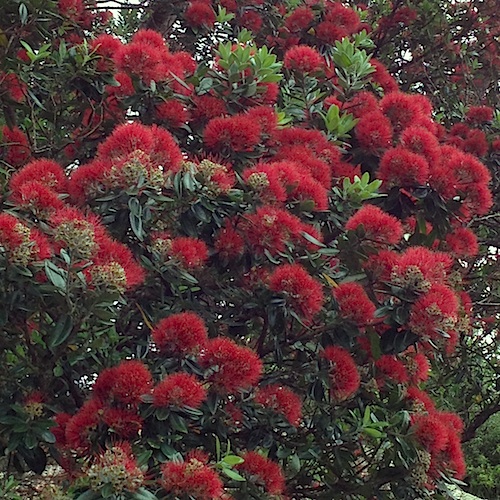
Pōhutukawa flowers
One of the interesting things weeds do well is reproduce.  All that any plant or animal needs to do is to reproduce itself at least once, but because an outcrossing sexual plant or animal contributes only one of its two sets of genes to each offspring it must do it twice to break even.  Even then, reproducing a few times doesn't guarantee the survival of all your genetic material, because which copies of genes get into a sperm or egg is random.  But some plants seem to reproduce in overdrive.

Weeds often succeed because they out-reproduce other plants.  Some are long-lived and may spread vegetatively, but others produce huge numbers of seeds.

A few red stamens have accumulated in the gutter beneath these trees, but sometimes, if it's not windy, a thick red carpet can build up.
Today's wildflower is a weed in the biological sense, but to New Zealanders it's a much-loved native flowering tree, the pōhutukawa, Metrosideros excelsa.  Pōhutukawa puts a lot of effort into reproduction, and that's probably why it's an unwanted weed in some other parts of the world where it has been introduced as an ornamental, like South Africa and Hawai'i.  Some people also consider it a weed in parts of New Zealand that are outside of its native range, such as Wellington, because it's invasive and aggressive there too.

A cluster of pōhutukawa flowers; each individual flower has about 25 red stamens (with yellow anthers) and one red style.
Pōhutukawa reproduction seems wasteful.  The trees flower profusely around Christmas time in New Zealand and in the later part of each flower's life the bright red stamens fall to the ground where they can form a thick red carpet.  This isn't over-production particularly; it's just that the red stamens are so visible and there are so many flowers producing them.  They can be dispensed with once their pollen has been dispersed.  They're visible for a good reason: pōhutukawa is primarily pollinated by birds (tūī, bellbirds, but also silvereyes and starlings) and the red colour attracts them because birds see well in the red wavelengths.

A bit later in the summer, many of the old flowers themselves fall.  I guess these are flowers that aren't setting seed; they no longer have a function and the plant can discard them.  I don't know whether these are functionally male flowers or simply flowers that didn't get pollinated, but these form a pale grey-green carpet for a time.

Pōhutukawa seeds in the gutter, Kelburn, Wellington
The third big dump of reproductive material is happening about now in Wellington, and that's the dispersal of seeds in their millions.  Most of these are never going to germinate.  They pile up in gutters, on footpaths, and at the bases of walls.  I'd like to do a rough calculation of the weight of stamens, aborted flowers, and seeds produced by a large pōhutukawa tree in a season; I think we'd all be surprised.  Multiply that, whatever it is, by the number of trees in Wellington and that's a lot of biomass falling to the ground each year.

Pōhutukawa seeds.
This prodigious reproductive effort is one of the attributes that makes pōhutukawa such a successful plant, and it's a trait normally associated with weediness.  No wonder then that our Christmas tree has become a pest in places.

Tuesday, 22 January 2013

Wednesday wildflower: moth plant


Moth plant isn't something I've noticed before, but this week I'm holidaying on Waiheke Island and seeing quite a few northern weeds.  Moth plant, Araujia sericifera, is one of these.

It's a twining climber that smothers shrubs and trees.  Moth plant was introduced probably as an ornamental, but like many it has escaped to become an environmental nuisance.  It's native to South America, although might have been introduced here from Europe, where it is cultivated.

The quite large (about 20-25 mm diameter) fragrant flowers are pollinated by moths, among other things.  It's also known as "cruel plant", seemingly because the petals close around pollinating moths at night and release them in the morning.
Parsonsia heterophylla flowers.  Scale = 5mm.

Our only native member of its family, Apocynaceae, is Parsonsia, with three species.