Wednesday, 31 July 2013

Wednesday wildflower: old man's beard.

“Old man’s beard must go,” said the not-so-young bearded botanist David Bellamy some years ago on TV, and we all knew this was a serious weed that threatened to smother our native forests.  Since then, it’s not as common as it used to be.  The efforts of the Department of Conservation, local and regional councils, community groups, and individual landowners have largely seen off the worst infestations in many places.  But around Wellington city, and probably many other places, there are little pockets of old man’s beard everywhere.  My guess is it’s waiting for our vigilance to let up and it’ll be back with a vengeance.
Old man's beard fruits, Northland, Wellington.
Old man’s beard is called traveller’s joy in England, which goes to show that one country’s wildflower is often another’s weed.  The local name refers to the fluffy white plumes on the seeds.  More accurately (with my pedantic botanist’s hat on) these aren’t seeds but fruits, each bearing a single seed inside a loose-fitting fruit wall.  The flower, like many in the buttercup family, has multiple separate pistils, each with its own ovary, style and stigma.  After pollination, the pistils from a flower mature into a cluster of separate 1-seeded fruits, each with the fluffy remains of the style to form a plume that assists in wind dispersal.

One of the practical problems with a public eradication campaign is that people need to be able to recognise the target weed, and not try to eradicate look-alikes.  Many people worry that they might be pulling up one of the native Clematis instead, so I thought this week a few notes about these plants might be useful.

First, old man’s beard (Clematis vitalba) is one of just two species in New Zealand with once-pinnate leaves; they have a central axis with a terminal leaflet and two pairs of lateral leaflets.  The other species that’s characterised by once-pinnate leaves is C. maximowiciana, but its leaves are more leathery than the leaves of old man’s beard; also it has larger flowers, 30–50 mm diameter.  Most of the other species have three leaflets although these can be quite finely divided.  Two species, C. tangutica (yellow flowers) and C. flammula (white flowers), have twice-pinnate leaves (the pinnae [leaflets] are themselves pinnately divided).  The native C. afoliata has no leaves at all, just the leaf stalks that twine around supporting shrubs’ stems.
Old man's beard flowers, Kakariki, Manawatu.  They are mostly 12–25 mm diameter
Secondly, the introduced species mostly have 4 sepals in each flower, but many (not all) of the native ones have six.  All the introduced Clematis have hermaphrodite flowers (with functional stamens and pistils) whereas the natives all have unisexual flowers on separate plants (flowers have either stamens or pistils, but never both).
Clematis forsteri, a native species.  Pale yellow male flowers with 6 sepals.  If you see these, don't just look, sniff too: many are sweetly scented.
Most of the native Clematis flower in the springtime or even late winter (some plants of C. forsteri are in flower now in late July).  Old man’s beard is a summer-flowering plant, mostly from December to May.

Clematis paniculata, another native species, male flowers.
Old man's beard flowers are greenish white.  Most natives have pale or greenish yellow flowers, although the large (and unisexual) flowers of C. paniculata are pure white, C. marata and C. marmoraria are white or greenish, and C. marata quadribracteolata (corrected 4 September 2013) brown or purplish brown.  Finally, the introduced Clematis are all deciduous whereas the natives are all evergreen (except poor C. afoliata, which hasn’t got leaves to lose).

Old man's beard still must go, but let's hope no native Clematis get pulled out instead by well-meaning weed-busters.  The Flora treatment for their identification is on line at Landcare Research's website and you can find pictures identified by botanists at the Naturewatch site..

Monday, 15 July 2013

Wednesday wildflower: winter heliotrope

Winter heliotrope isn't a true heliotrope, but a daisy, related to the senecios I've featured in a few other entries in this series (here and here).  But it is both a wildflower and a weed, a garden plant that has escaped.
Winter heliotrope, Petasites fragrans.

This patch was in Aro Valley, an old-established part of Wellington, originally working class but now a mix of gentrified old cottages and student flats, arty cafes and boutiques.  The plants were in a garden that had a rather wild appearance; I'm sure its owner was deliberately aiming for a wilderness look.
Winter heliotrope flower heads.

The flowers are pink, instead of the usual yellow for this tribe of daisies (Tribe Senecioneae, characterised by the involucral bracts being in a single row, not in overlapping rows like roof shingles).  Winter heliotrope is dioecious (has separate male and female plants), but all the plants in New Zealand are males.  Their outer ray florets are all sterile (they make neither pollen nor seeds); ray florets are female in most daisies (the general structure of daisy flower heads is explained here).  The inner disk florets are male (often hermaphrodite in other daisies).  Not being able to have sex doesn't deter this plant a bit, because it is able to spread vegetatively, and of course people deliberately and inadvertently help that process.

You might note the stigmas in these florets, the large white somewhat feathery things poking through the tube of purple anthers in the centre of these florets.  How come male florets have such a large stigma?  In this and several other families, the pollen is presented on the stigma, so even though the florets are male, they still need well-developed female parts for pollen dissemination.  In a hermaphrodite daisy floret, the stigma opens after the pollen has gone to expose the two receptive surfaces.  I didn't examine these closely at the time, but in the photo I can't see any that have opened.

Wednesday, 3 July 2013

Wednesday wildflower: German ivy, Delairea odorata

It's Thursday evening in New Zealand, but it's still Wednesday on the west coast of North America and the eastern Pacific, so if I'm quick I can post a Wednesday Wildflower on time.  I haven't posted here much lately, but I'm working enthusiastically on a new project that I'll write about soon.
German ivy on a bank in Karori, Wellington, with broom, Cytisus scoparius.
Delairea odorata is a climbing senecioid weed that's native to southern Africa and common around Wellington and tends to flower in the winter.  It sprawls over banks and other plants.
Some of the flower heads of a panicle of German ivy (iPhone with Ōlloclip macro)
The flowers are in small heads and there are no ray florets, only disc florets (compare with my post on the distantly related Roldana).  The small heads are arranged into larger panicles that are quite showy and rather unpleasantly scented (in my opinion; it's very subjective).
A single capitulum (head) of German ivy.  Note the absence of petal-like ray florets and the evident filaments at lower right.
Under the microscope, you can see how the anthers are joined together in a tube that surrounds the style, but the filaments (anther stalks) are separate.  That's a characteristic of the whole family.  The senecioids (Tribe Senecioneae) are characterised by having their involucral bracts (the sepal-like leaves that surround the base of the head) all in a single row.


Wednesday, 22 May 2013

Wednesday Wildflower: Brazilian pepper tree

I've been wondering about some trees in Sunnynook Park every time I visit Auckland.  From the shape of their leaves and their panicles of small flowers I had assumed they're something in the Cunoniaceae. But I should have been more curious and looked more closely, because these leaves are alternate, whereas Cunoniaceae have opposite leaves with interpetiolar stipules.

Schinus terebinthifolius, a flowering branchlet from a female tree.
This week I was there again and saw one of the trees had little round pinkish fruits, and I realised this is Schinus terebinthifolius.  I knew S. molle, which has more graceful hanging leaves, and I knew the fruits of S. terebinthifolius are the pink peppercorns you sometimes see mixed with black peppercorns (Piper nigrum) in pepper grinders. (Pink pepper, confusingly, is made with true black peppercorns, using newly-ripened berries and treating them with brine and vinegar, described by McGee, 2004.)


It's becoming a bit of a problem weed in New Zealand and worrying some weed experts.  Back in 1988, Flora of New Zealand Vol. 4 didn't record it as naturalised (Webb et al. 1988), but now it seems to be establishing.  It's a major weed in many warmer countries.  The trees in Sunnynook Park don't seem to be spreading, although there appear to be suckers coming up from the roots.  Most of the trees there are male, but I did spot a couple of females.

It seems a lot of our new weeds are woody, and many are bird-dispersed.  I wonder how many originate from more tropical climates and owe their success here to climate change.

The Flora says it has 5–9 leaflets.  The leaf I randomly chose to photograph had 11:
Schinus terebinthifolius leaf
That doesn't mean the identification is wrong.  Many characteristics of plants are more variable than the descriptions cover, partly because the descriptions are based on a smallish sample that doesn't allow for the odd extreme.

Pink pepper is in the family Anacardiaceae, the same family as mango, cashew, and poison ivy; some people are very allergic to this family.  According to McGee (2004) it owes its peppery flavour to cardanol, an irritating phenolic compound.

References.

McGee, H. 2004.  On food and cooking, the science and lore of the kitchen. (Revised edition), Scribner.

Webb, C.J.; Sykes, W.R.; Garnock-Jones, P.J. 1988.  Flora of New Zealand Vol. 4.  Botany Division, DSIR.

Wednesday, 15 May 2013

Wednesday wildflower: Red carpet, brown carpet

When I use the term wildflower, it's often to avoid the judgmental term "weed".  I like most plants, and if other people have species they don't like, well, that doesn't necessarily stop me enjoying them.  Furthermore, plants we designate as weeds are often biologically very interesting.  To a botanist, the term "weediness" has an ecological meaning that signifies more than a nuisance plant.

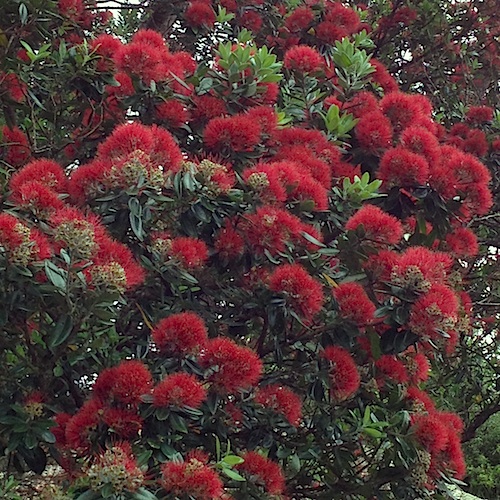
Pōhutukawa flowers
One of the interesting things weeds do well is reproduce.  All that any plant or animal needs to do is to reproduce itself at least once, but because an outcrossing sexual plant or animal contributes only one of its two sets of genes to each offspring it must do it twice to break even.  Even then, reproducing a few times doesn't guarantee the survival of all your genetic material, because which copies of genes get into a sperm or egg is random.  But some plants seem to reproduce in overdrive.

Weeds often succeed because they out-reproduce other plants.  Some are long-lived and may spread vegetatively, but others produce huge numbers of seeds.

A few red stamens have accumulated in the gutter beneath these trees, but sometimes, if it's not windy, a thick red carpet can build up.
Today's wildflower is a weed in the biological sense, but to New Zealanders it's a much-loved native flowering tree, the pōhutukawa, Metrosideros excelsa.  Pōhutukawa puts a lot of effort into reproduction, and that's probably why it's an unwanted weed in some other parts of the world where it has been introduced as an ornamental, like South Africa and Hawai'i.  Some people also consider it a weed in parts of New Zealand that are outside of its native range, such as Wellington, because it's invasive and aggressive there too.

A cluster of pōhutukawa flowers; each individual flower has about 25 red stamens (with yellow anthers) and one red style.
Pōhutukawa reproduction seems wasteful.  The trees flower profusely around Christmas time in New Zealand and in the later part of each flower's life the bright red stamens fall to the ground where they can form a thick red carpet.  This isn't over-production particularly; it's just that the red stamens are so visible and there are so many flowers producing them.  They can be dispensed with once their pollen has been dispersed.  They're visible for a good reason: pōhutukawa is primarily pollinated by birds (tūī, bellbirds, but also silvereyes and starlings) and the red colour attracts them because birds see well in the red wavelengths.

A bit later in the summer, many of the old flowers themselves fall.  I guess these are flowers that aren't setting seed; they no longer have a function and the plant can discard them.  I don't know whether these are functionally male flowers or simply flowers that didn't get pollinated, but these form a pale grey-green carpet for a time.

Pōhutukawa seeds in the gutter, Kelburn, Wellington
The third big dump of reproductive material is happening about now in Wellington, and that's the dispersal of seeds in their millions.  Most of these are never going to germinate.  They pile up in gutters, on footpaths, and at the bases of walls.  I'd like to do a rough calculation of the weight of stamens, aborted flowers, and seeds produced by a large pōhutukawa tree in a season; I think we'd all be surprised.  Multiply that, whatever it is, by the number of trees in Wellington and that's a lot of biomass falling to the ground each year.

Pōhutukawa seeds.
This prodigious reproductive effort is one of the attributes that makes pōhutukawa such a successful plant, and it's a trait normally associated with weediness.  No wonder then that our Christmas tree has become a pest in places.

Tuesday, 7 May 2013

The Barber's

Getting a haircut in the 50s and 60s was a very masculine thing.  The Barber’s was an all male environment and you had to know, really know, how to behave there.  If your mother came in with you, she wouldn’t stay long (you’d hope).

The Barber was a wizened and enigmatic character, his thinning hair Brylcreemed back, or sidewards in a comb-over if it was thinning too much.  His face was haggard and he smoked; he looked a bit like a jockey.  You didn’t want to piss this guy off: he could kick you out of the shop, or probably something worse.
My first haircut in New Zealand was in 1955, in Whanganui.  I don’t remember getting it cut in England, but oh boy this was memorable.  The shop smelled of Bay Rum, Brylcreem, and cigarette smoke. I was five.  My Dad took me, and The Barber had this enormous wrought iron barber’schair. I was thinking, “how am I going to get up into that?”, when he produced a seat on a plank that sat across the arm-rests, and lifted me up onto it.  It had leather padding and its own little arm-rests, and I felt really special.  But the hand-operated clippers pulled at my hair and I squirmed.  Eventually The Barber got so grumpy he whacked me over the head with the handles of the scissors.  I didn’t dare cry, and Dad didn’t come to my rescue, such was the manly power of The Barber.
Later, in Tawa, The Barber’s became a regular ritual.  You’d be dropped off there to wait your turn and get your hair cut, usually on a Friday after school.  There was a long bench seat that ran around three sides of the shop, and you took your place at one end and shuffled along as each boy’s hair was done.  Sometimes there were too many waiting and you had to stand until a seat became free.  There were comics to read, and that was the best thing.  We were only allowed “Classics” comics at home, which told the stories of Dickens and the like in comic form, but here was the real thing: Phantom, all the Disney characters, and best of all, war comics.  Battler Britton, scrambled by an air raid during a cricket match on the village green, runs out of ammo over occupied France, and bowls the cricket ball he had stuffed into his battledress pocket to switch over the railway points and send the German ammunition train crashing into a horrendous explosion!  We always drew Spitfires and Hurricanes on the backs of our school books.
The Barber had a big poster behind the counter.  It was a kangaroo, leaping, with envelopes spilling out of its (her) pouch, and the caption “We post to Australia”.  I sat and stared at this, and I still don’t know what it meant.  I suspect it had to do with gambling; maybe the barber was an agent for Tattersall’s Lottery or something.  It was all exotic and dark.  Men, real men who smoked and swore, would come in, and the barber would leave off cutting hair and go behind the counter.  There would be a quiet conversation and money would change hands, but I never understood what was going on.  Later I learned that barbers sold condoms (we called them “Frenchies”), but I always suspected these clandestine transactions had something to do with the flying kangaroo.
After an hour or two of comics and shuffling along the bench, you’d finally get to have your hair cut.  It was always a bit off the top and short back and sides, even if you asked for something else.  When the cutting was done, he’d violently rub in some Brylcreem, slapping your head about in the process, comb and brush your hair into a bit of a style, flick the cut hairs off your collar, and finish off with a little spray of smelly stuff.  Everyone’s hairstyle was the same. 
By about 1964 we all wanted Beatles haircuts, long enough to be thought Fab, but short enough not to earn a detention.  The barber never understood this; we all walked out with short back and sides, then put off our next visit as long as we could and combed our hair, what was left of it, forward as much as we could; making the best of a bad job, a bit like The Barber’s comb-over.
After the barber’s, if you were lucky, was fish and chips for dinner, and you could buy a classic comic at the bookshop, or a 45 rpm record.  I remember buying “A Fool Such As I” by Elvis Presley.  I’ve still got it somewhere.  But no more barber’s for me; I don’t have enough hair any more.

Wednesday, 24 April 2013

Lila's big day out.

It’s ANZAC Day, New Zealand’s day to remember the war dead.  It’s an important day for my family too, because we arrived in New Zealand on ANZAC Day (April 25) 1955 on the MV Ruahine. 
Today it rained on and off all morning, so when the sun came out after lunch we had to get out for a walk.  Rufus was happy inside, but Lila was out in the garden and decided to follow us.  We tried to outrun her, but in the end decided to give in and let her come with us.
So she tagged along quite happily for the first 500m or so and then seemed to get a bit tired.  She was very wary the whole time, probably because she was out of her territory and in a place of new smells and sounds.
You might feel it’s wrong to take a cat into the bush, especially so close to Zealandia.  First, she’s not a hunter (yes I know cat owners always say that, like dog owners say their dogs don’t bite).  Secondly, she was too busy keeping up with us and watching her back.  Thirdly, and I know it’s not a valid argument but I’ll make it anyway, lots of cat-owning households back onto that bush and people walk their dogs there all the time.  I agree with Gareth Morgan that cats should be enclosed so they can’t hunt birds and lizards.
It’s autumn now.  The drought is well and truly behind us and fruits and fungi were the features of this walk.
Favolaschia calocera
Favolaschia calocera is an introduced fungus that lives on dead wood.  It’s become very common around Wellington.  Under the cap are large pores instead of gills.
Under the cap of Favolaschia calocera are honeycombed pores.

Buds of kohekohe, Dysoxylum spectabile.
Kohekohe (Dysoxylum spectabile) is going to have a bumper flowering this year.  The sprays of small white flowers are produced on the tree trunks, and a number were quite low down.  When these open, I’ll easily be able to reach them and get good photos.  Individual trees are either male or female, although some males can set a few fruits.
Outside the bush, the track follows the Zealandia pest-proof fence alongside a clay banks with a nice range of mosses and lichens and a view of the harbour.  We didn’t go far along, because Lila was clearly getting tired by now.
Passiflora fruits, one eaten by birds
Native passion flower (Passiflora tetrandra) was in fruit.  Orange rinds littered the ground where birds had opened the fruits for their meagre pulp and few seeds.  I found one intact one.
Inside the Passiflora fruit are bright red seeds and pulp.
The fruit has three parts (carpels) and the ovules and (later) seeds are attached in three rows to the outer walls where they join.

Home at last, Lila staggered in the door and immediately collapsed on the cool wooden floor.  She’ll sleep well tonight.